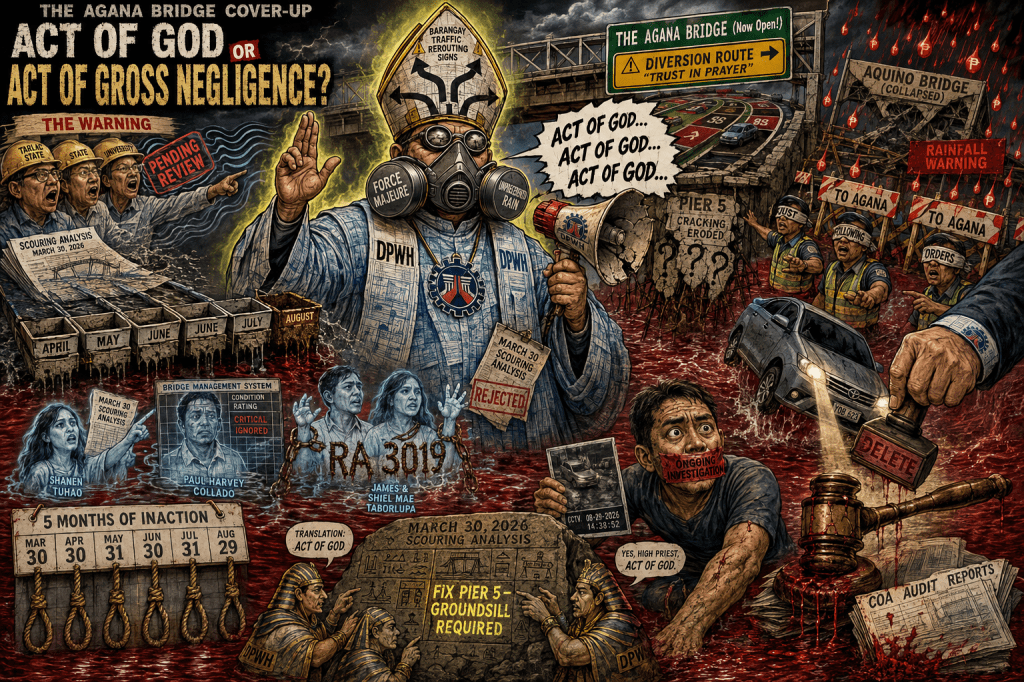
The Typhoon Didn’t Kill Them—Bureaucratic Indifference Did
By Louis ‘Barok‘ C. Biraogo — August 31, 2026
THE Tarlac River, swollen by a predictable monsoon, has become a mass grave.
Four souls—Shanen Tuhao, Paul Harvey Collado, and the Taborlupa couple—were swallowed by the current on the night of August 29, 2026. Their vehicle, a gray Toyota Avanza, plunged into the churning water when the Agana Bridge, their designated path to safety, disintegrated beneath them.
For the Department of Public Works and Highways (DPWH) and the City Government of Tarlac, the talking points are already memorized: Act of God. Unprecedented rainfall. Sudden hydraulic forces.
It is a convenient liturgy, a ritualistic incantation designed to absolve the state of its most fundamental duty: ensuring that public infrastructure does not kill its citizens.
But buried beneath the sediment of official press releases lies a document that transforms this tragedy from an unfortunate accident into a potential indictment.
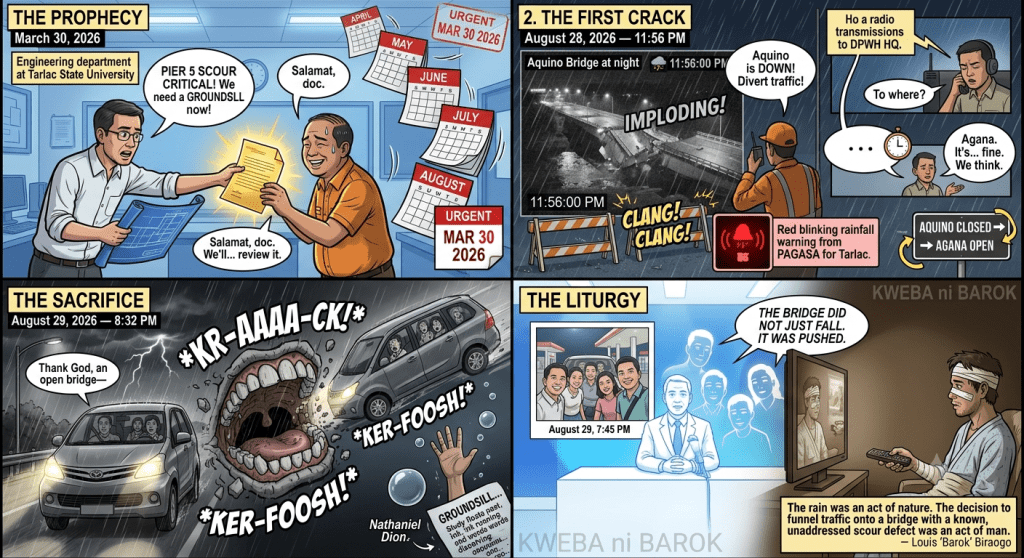
A technical record, dated March 30, 2026, reveals that the Tarlac State University Civil Engineering Department handed the DPWH a completed scouring analysis specifically concerning Pier 5 of the Agana Bridge. They didn’t just sound an alarm; they delivered the blueprints for a fix—a proposed “groundsill” to arrest the erosion eating away at the bridge’s foundation.
Five months. The state had five months between receiving a targeted engineering study on a known structural vulnerability and the moment that vulnerability—allegedly—gave way, dropping an SUV into the abyss.
This is no longer a story about the weather. This is a story about the lethal latency of Philippine bureaucracy.
The Anatomy of a Foreseeable Failure
Let us reconstruct the state’s logic on that fateful day.
At 11:56 p.m. on August 28, the Aquino Bridge—a decrepit structure named after a martyred icon—collapses under the strain of the habagat. The response is swift. Barricades go up. Personnel are deployed.
And where does the DPWH send the terrified public? Straight to the Agana Bridge.
This is not merely reckless; it is institutionally insane. The government knew Agana was compromised.
The March study is the smoking gun, evidence that the DPWH was in possession of knowledge that the bridge’s structural integrity was actively threatened by scour. To divert traffic toward a bridge with a documented, unmitigated scour vulnerability during a once-in-a-year hydrological event is not a clerical error; it is a masterclass in bureaucratic malpractice.
The DPWH might argue the study was merely “advisory.” They might claim the flood exceeded the study’s parameters. But that defense crumbles against the weight of the chronology.
The Aquino Bridge failed first. The river was already violent. The city was under red rainfall warning. This was not a “sudden” event; it was an unfolding catastrophe in slow motion.
The decision to keep Agana open, to use it as the lifeboat for a sinking city, represents a profound failure of risk assessment.
A Tale of Two Defenses: Act of God vs. Act of Gross Negligence
The government’s legal shield, the doctrine of force majeure, is as flimsy as the rusted rebar likely exposed beneath the Agana Bridge.
While the Civil Code excuses unforeseeable events, the Philippine monsoon is not a bolt from the blue. It is an annual certainty. The Supreme Court has consistently held that “Acts of God” must be extraordinary and unforeseeable. A heavy rainy season in the Philippines is neither.
More damning is Article 2189 of the Civil Code. It is a brutally simple statute: Provinces, cities, and municipalities shall be liable for deaths caused by the defective condition of public works under their control.
The jurisprudence—most notably City of Manila v. Teotico—has shredded the State’s immunity defense, holding that “control or supervision,” not ownership, triggers liability.
Here, the control is undeniable. The city designated the route. The DPWH restricted trucks, acknowledging they knew the bridge was fragile. They were “monitoring” it. They were in command. They were in control. And they failed.
The investigators must now ask the uncomfortable questions that the DPWH dreads. Did the March 2026 study sit on a desk in Manila? Was the proposed groundsill rejected due to budget constraints? Was the “technical analysis” of the DPWH’s in-house engineers overruled by a politician more concerned with traffic flow than hydrology?
The Anti-Graft and Corrupt Practices Act (RA 3019) isn’t just about bribery; it covers “gross inexcusable negligence.” If the DPWH received a specific engineering fix for Pier 5 and did nothing while actively routing traffic toward Pier 5, that crosses the threshold from simple incompetence into actionable, prosecutable neglect.
The Institutional Arrogance of the DPWH
This is not an isolated incident. It is a symptom of a rotting system.
The Commission on Audit (COA) has repeatedly flagged the DPWH for hundreds of “defective” projects. The stench of the “ghost project” scandals—billions of pesos for flood control that vanished into thin air—still lingers over the agency.
The Tarlac collapse is the physical manifestation of this paper corruption. When you pay for concrete that isn’t poured and steel that isn’t installed, you get bridges that fall down.
The DPWH’s Bridge Management System is a sad joke. It is supposed to prioritize maintenance based on annual inspections.
But if the Agana Bridge had a “Scour Study” completed in March, what was its condition rating in August? If the system worked, the rating should have been “Critical.” If it was “Critical,” why was it open to a Toyota Avanza with five passengers?
The answer is simple: In the Philippines, engineering facts are subordinate to political expediency. Closing a bridge is unpopular. It causes traffic. It angers mayors. It is easier to roll the dice, to trust in prayer, and to blame God when the concrete finally gives way.
The Final Verdict
The lone survivor, Nathaniel Dion, pulled from the river, is a witness to a crime of omission.
The families of the missing deserve more than a search-and-retrieval operation; they deserve a forensic audit of the state’s conscience.
The March 30 scouring analysis is the Rosetta Stone of this tragedy. It decodes the language of the disaster. It proves that the state knew what was wrong and where it was wrong. The only thing missing was the will to fix it.
We must not allow the DPWH to hide behind the “Act of God” narrative. The rain was an act of nature. The decision to funnel traffic onto a bridge with a known, unaddressed scour defect was an act of man.
And in the calculus of justice, the latter weighs heavier than any storm cloud. The bridge did not just fall. It was, to use a technical term, pushed—pushed by years of neglect, months of inaction, and a final, fatal decision to treat a compromised structure as a viable escape route.
The ghosts of Agana Bridge are not asking for sympathy. They are demanding an autopsy of the bureaucracy that sent them to their deaths.
Key Citations
A. Reports & Studies
- United States Geological Survey. What Is Scour? Open-File Report 93-480, U.S. Department of the Interior, 1993, https://pubs.usgs.gov/of/1993/ofr93-480/.
- Department of Public Works and Highways. Road and Bridge Inventory Application / Bridge Management System. ArcGIS, https://www.arcgis.com/home/item.html?id=4bc4f2dc3a5644088c57de02108a8fd3.
B. News Articles
- Calayag, Madelle. “4 Missing, 1 Rescued after SUV Falls as Another Tarlac Bridge Collapses.” Inquirer.net, 29 Aug. 2026, https://newsinfo.inquirer.net/2295013/4-missing-1-rescued-after-suv-falls-as-another-tarlac-bridge-collapses.
- GMA News. “2nd Bridge in Tarlac City Collapses amid Habagat Rains.” GMA News Online, 29 Aug. 2026, https://www.gmanetwork.com/news/topstories/regions/1000374/2nd-bridge-in-tarlac-city-collapses-amid-habagat-rains/story/.
- GMA News. “Part of Aquino Bridge in Tarlac City Collapses amid Habagat Rains.” GMA News Online, 28 Aug. 2026, https://www.gmanetwork.com/news/topstories/regions/1000300/part-of-aquino-bridge-in-tarlac-city-collapses-amid-habagat-rains/story/.
- Sarabia, Abi M. “DPWH Inspects Aquino Bridge in Tarlac after Damage from Heavy Rains.” Philippine Canadian Inquirer, 30 Aug. 2026, https://canadianinquirer.net/2026/08/30/dpwh-inspects-aquino-bridge-in-tarlac-after-damage-from-heavy-rains/.
- Daguno-Bersamina, Kristine. “Red Rainfall Warning Still Up over Metro Manila, Other Luzon Areas.” Philstar.com, 29 Aug. 2026, https://www.philstar.com/headlines/weather/2026/08/29/2552633/red-rainfall-warning-still-over-metro-manila-other-luzon-areas.
- “Flood Control Projects Scandal in the Philippines.” Wikipedia, Wikimedia Foundation, https://en.wikipedia.org/wiki/Flood_control_projects_scandal_in_the_Philippines.
C. Official Websites
- Department of Public Works and Highways. Official Website. Republic of the Philippines, https://www.dpwh.gov.ph/.
- City Government of Tarlac. Official Website. https://tarlaccity.gov.ph/.
- Tarlac State University. “College of Engineering.” https://www.tsu.edu.ph/academics/colleges/college-of-engineering/.
- Philippine Atmospheric, Geophysical and Astronomical Services Administration. Official Website. DOST, https://www.pagasa.dost.gov.ph/.
- Commission on Audit. Official Website. Republic of the Philippines, https://www.coa.gov.ph/.
- Toyota Motor Philippines. “Toyota Avanza.” https://toyota.com.ph/avanza.
D. Laws & Jurisprudence
- Republic of the Philippines. Civil Code of the Philippines. Republic Act No. 386, 18 June 1949, https://www.officialgazette.gov.ph/1949/06/18/republic-act-no-386/.
- Republic of the Philippines. Anti-Graft and Corrupt Practices Act. Republic Act No. 3019, 17 Aug. 1960, https://www.officialgazette.gov.ph/1960/08/17/republic-act-no-3019/.
- City of Manila v. Teotico. G.R. No. L-23052, 29 Jan. 1968, Supreme Court of the Philippines, https://www.lawphil.net/judjuris/juri1968/jan1968/gr_l-23052_1968.html.
- “Rain Check: Excessive Rain as a Fortuitous Event.” ACCRALAW, 10 Aug. 2023, https://accralaw.com/2023/08/10/rain-check-excessive-rain-as-a-fortuitous-event/.
- ₱8B BBM Pork: CCTV for Every Captain’s Kumpare?
- ₱8.9 Billion, 331 Ghost Police Stations: The TIKAS Scandal Explained

- ₱8.4 Billion, 42,000 Barangays, 1 Election: The “Bawat Barangay Makikinabang” Vote-Buying Masterclass

- ₱75 Million Heist: Cops Gone Full Bandit

- ₱6.77B Ghost Haunts Duterte: RTC Dismisses Mans Carpio’s Desperate Plea
- ₱6.77 Billion and Zero Cash: The Sara Duterte SALN Math That Doesn’t Add Up

- ₱6.7-Trillion Temptation: The Great Pork Zombie Revival and the “Collegial” Vote-Buying Circus

- ₱58.53B, Zero Receipts: The LGSF Pork Barrel Nobody Wants to Name
- ₱53 Million Man Tells ₱695-a-Day Workers to Stop Being ‘Mayabang’: The Audacity of BSP’s Remolona
- ₱3.06 Billion for Evacuation Centers—But Nobody Knows Where They’ll Stand (Or If They’ll Exist)
- ₱10B Ghost in New Clark City: Matibag’s Haunted Séance for Cayetano

- ₱1.9 Billion for 382 Units and a Rooftop Pool: Poverty Solved, Next Problem Please





Leave a comment