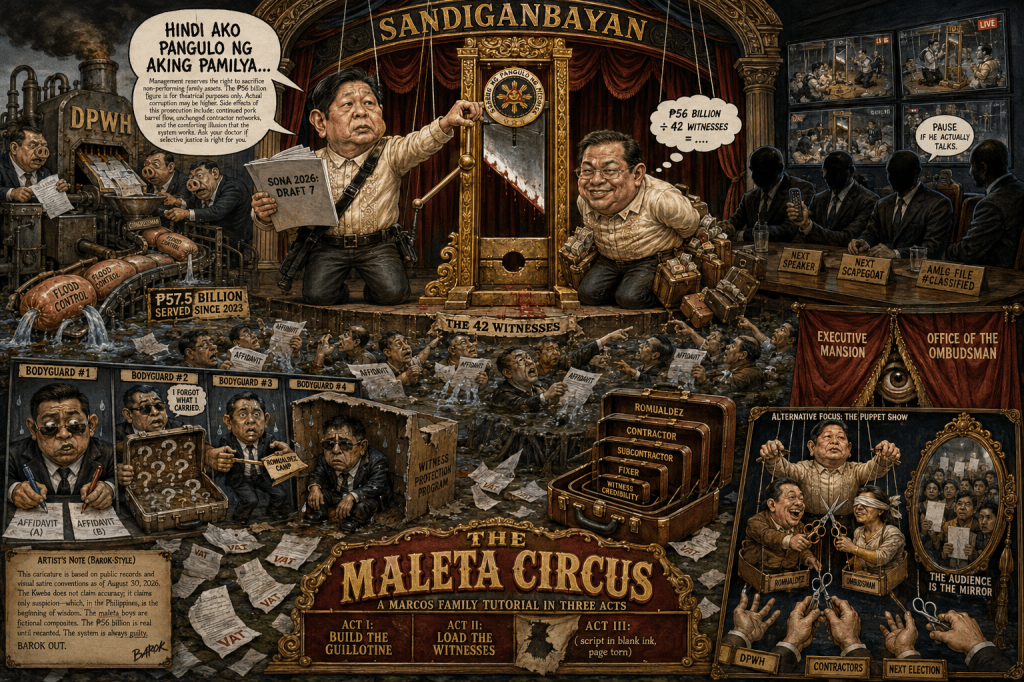
A Step-by-Step Guide to Selective Justice, Political Survival, and Keeping the ₱57.5 Billion Pork Barrel Flowing
By Louis ‘Barok’ C. Biraogo — August 31, 2026
MGA ka-kweba, there is a particular kind of farce that unfolds when the powerful suddenly discover that the machinery of accountability—normally oiled for the benefit of the connected—has unexpectedly turned its gears in their direction. It is the farce of the man who built the guillotine being led to it, blindfolded, by his own cousin.
The Office of the Ombudsman, that peculiar Philippine institution designed to project constitutional virtue while navigating the swamp of political reality, now claims to possess forty-two witnesses against former Speaker Martin Romualdez. The charge? Plunder. Graft. Bribery. Money laundering. The amount? A sum so astronomical—₱56 billion—that it would make even the most hardened pork-barrel aficionado pause mid-bite.
But let us not be seduced by numbers, for numbers are the magician’s first trick. The question that should keep every Filipino awake at night is not how many witnesses exist, but what they actually saw—and who is paying them to forget.
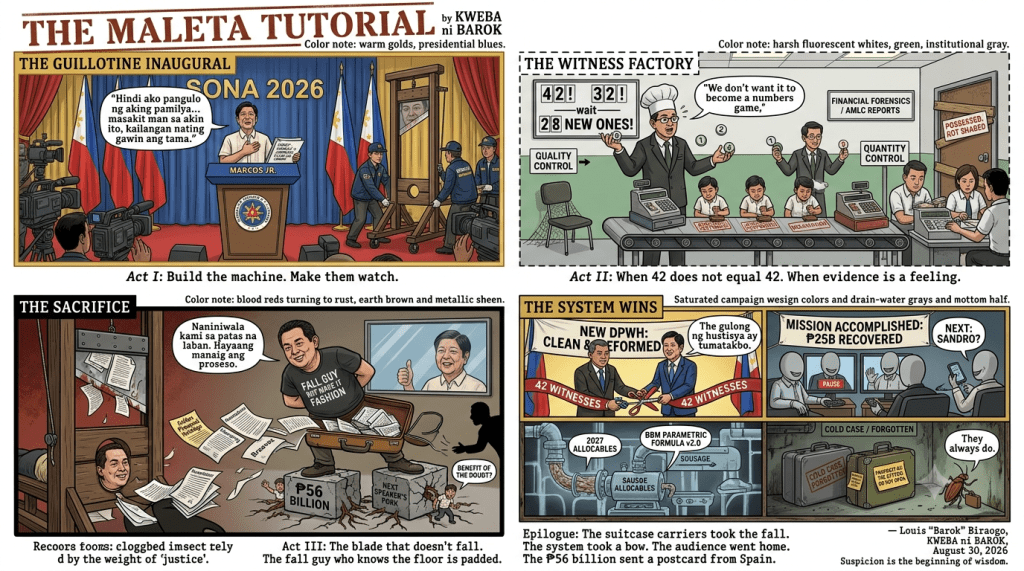
The Arithmetic of Accusation: When 42 Does Not Equal 42
Assistant Ombudsman Mico Clavano, in a moment of either refreshing candor or strategic deflection, declared: “We don’t want it to become a numbers game.”
Pity. Because that is precisely what the Ombudsman is playing.
The original narrative was delicious in its simplicity: eighteen “maleta boys”—bodyguards employed by former Ako Bicol Rep. Zaldy Co—allegedly delivered suitcases of cash to Romualdez. Cash allegedly skimmed from the DPWH trough that has fed Leyte’s first district with ₱57.5 billion in total project allocations since 2023. Cash that allegedly reached ₱56 billion in personal kickbacks between 2022 and 2025.
Now, four have recanted. Romualdez’s camp claims thirty-two total withdrawals. Twenty-five former Co personnel have submitted counter-affidavits disputing the delivery narrative entirely.
The Ombudsman’s response? Find more witnesses. Twenty-eight of them, to be precise. Witnesses whose primary purpose, Clavano admits, is “to controvert the recantations.”
Read that again.
The Ombudsman is not seeking witnesses to corroborate the original allegations. It is seeking witnesses to disprove the disproof. This is not investigation; this is epistemological whack-a-mole. Each recantation spawns a new witness whose function is not to testify about what happened, but to testify that the people who changed their story were lying then or lying now. The truth becomes whatever survives the latest round of affidavit wars.
This is what happens when a case is built on the shifting sands of human memory, fear, and—allegedly—cash payments rather than the solid bedrock of documentary evidence.
Recantation Is Not an Eraser—But Neither Is It Proof of Bribery
The Ombudsman’s legal position is, I must concede, jurisprudentially sound. The Supreme Court has held repeatedly—in Molina v. People and People v. Bensurto—that recantation does not automatically vitiate original testimony. The High Court views recantation with what can only be described as institutional suspicion, warning that witnesses can be purchased as easily as a congressman’s loyalty.
But here is the uncomfortable corollary that the Ombudsman’s public relations machinery would prefer you ignore: the same suspicion applies equally to the original testimony.
If a witness can be bribed to recant, he can be bribed to accuse. If a recantation is suspiciously vague, so too might the original affidavit be suspiciously detailed—the product not of memory but of coaching. The Ombudsman has fallen into a logical trap of its own making: it asserts that witnesses were paid to change their stories, while refusing to countenance the possibility that they were paid—or pressured, or politically motivated—to create those stories in the first place.
The Ombudsman says it has “information” that witnesses were paid to recant. Information. Not evidence. Not proof. Not even a named source. This is the investigative equivalent of saying “I have a feeling” and expecting the Sandiganbayan to issue a warrant.
I am not naive enough to believe that witness-tampering is rare in Philippine high-stakes cases. The very fact that recantations are jurisprudentially common in this country reflects a system where the powerful routinely purchase silence. But the Ombudsman cannot simply assert bribery as a fact; it must prove it. And if it proves it, it must also answer the uncomfortable question: who paid the witnesses to testify in the first place?
The Money Trail That Isn’t
This brings me to the most glaring omission in the Ombudsman’s carefully constructed narrative: where is the money?
₱56 billion is not a figure that disappears into the ether. It is a sum so vast that it would require a logistical operation rivaling a military campaign to move, store, and launder. Yet what we have are… suitcases. Cash. Alleged deliveries by bodyguards who have now developed selective amnesia.
The Ombudsman speaks confidently of money laundering charges, and the Anti-Money Laundering Act (AMLA) requires actual transactions—concealment, conversion, movement through financial systems. The Ombudsman claims possession of bank records, corporate registrations, real estate acquisitions, remittance trails, and AMLC reports. But possession is not proof, and claims are not evidence. The public has seen none of it. No redacted AMLC summary. No financial flow chart. No direct linkage between documents and Romualdez. Only witness counts—and witnesses, as we are learning, have a troubling habit of changing their minds when the price is right.
Assistant Ombudsman Clavano would have us believe that the case is about “quality,” not quantity. But quality means documentary evidence. It means financial forensics. It means a paper trail that does not depend on whether a bodyguard remembers which suitcase went where and when.
If the Ombudsman possesses such evidence, it should stop feeding the public a steady diet of witness-counting and start revealing the receipts. If it does not possess such evidence, then what we are witnessing is not a prosecution but a pantomime of prosecution—a theatrical production designed to convince the public that justice is being pursued while the evidentiary foundation remains as solid as a Leyte flood control project after the first typhoon.
The Family Business: Marcos, Romualdez, and the Art of Political Sacrifice
Now we arrive at the heart of the matter, the part that makes this case so deliciously, darkly fascinating: the President is prosecuting his own cousin.
Ferdinand Marcos Jr., the beneficiary of one of the most successful historical revisionism campaigns in modern political history, stood before the nation at his State of the Nation Address (SONA) and declared: “Hindi ako pangulo ng aking pamilya.” I am not the president of my family.
No, Mr. President. You are the president of a family that has spent decades perfecting the art of political survival. And this statement, while perhaps genuinely painful, is also exquisitely calculated.
Consider the context. The Philippine Center for Investigative Journalism (PCIJ) reports that Romualdez’s district received ₱57.5 billion in DPWH funds during his speakership—more than Paolo Duterte received during his father’s presidency. The pattern is unmistakable: political influence, not infrastructure need, determines flood control allocations. This is systemic. This is how the sausage is made.
By sacrificing Romualdez, Marcos achieves multiple objectives simultaneously:
- Anti-corruption credibility. With the Financial Action Task Force (FATF) watching, with international investors circling, with the public increasingly cynical about the Marcos brand’s commitment to anything beyond self-enrichment, a high-profile prosecution of a family member is political gold.
- Power consolidation. Romualdez, as Speaker, had built an independent power base within the House. His resignation—and subsequent replacement by Romualdo Dy, a Marcos loyalist—removes a potential rival while maintaining the family’s grip on the legislative agenda.
- Selective accountability. By focusing on Romualdez, the administration implicitly sends a message: we are cleaning house, but only the rooms we choose. The systemic corruption remains untouched. The contractor networks continue. The pork barrel merely changes hands.
The question that no one in Malacañang will answer is this: if the system produced ₱56 billion in alleged theft under Romualdez, who else knew? Who at DPWH signed the contracts? Who at the Department of Budget and Management approved the allocations? Who at Malacañang coordinated the legislative agenda that made these insertions possible?
Zaldy Co—the fugitive now hiding in Europe—has already claimed that ₱1 billion in bribes reached Justice Undersecretary Jojo Cadiz, allegedly on Marcos’s behalf. He claims former Budget Secretary Amenah Pangandaman instructed ₱100 billion in insertions. He claims Presidential Legislative Liaison Office Undersecretary Adrian Bersamin handed him project lists at Malacañang itself.
These allegations are, of course, unproven. But they are also convenient—for the administration. Romualdez becomes the designated villain, the singularly corrupt actor whose removal restores the system’s virtue. The structural corruption remains, waiting for the next Speaker to tap its veins.
The Witnesses: Pawns in a Game They Don’t Understand
Spare a thought, if you will, for the maleta boys.
These are not sophisticated political operatives. They are bodyguards—men whose job was to carry things and ask no questions. They are the last people in the chain of command, the ones who held the suitcases but never saw the ledgers. And now they find themselves at the center of a national scandal, their signatures—and their recantations—worth more than their lives.
Senator JV Ejercito has urged investigators to “give the maleta boys the benefit of the doubt.” This is either profound wisdom or profound naivety. The benefit of the doubt is precisely what they cannot afford. They are now assets to be managed—by the Ombudsman seeking to preserve its case, by Romualdez’s camp seeking to destroy it, by Co’s camp seeking to spread the blame, and by the administration seeking to control the narrative.
Each witness faces an impossible choice: testify truthfully and risk retaliation from powerful people they once served; recant and risk perjury charges from the Ombudsman; remain silent and face the possibility of becoming the fall guy for everyone else’s crimes.
The Ombudsman’s decision to seek criminal prosecution of recanting witnesses—if indeed bribery can be proven—is legally sound. But it is also strategically dangerous. It sends a message to every other potential witness: once you sign, there is no going back. In a system where witness protection is more theoretical than practical, this may produce not more truth but more carefully crafted lies designed to avoid liability on all sides.
The Real Trial: Philippine Institutions in the Dock
Ultimately, the Romualdez case is not about Martin Romualdez. It is about whether Philippine institutions can survive contact with Philippine politics.
The Ombudsman was designed to be independent, and Remulla deserves the benefit of the procedural doubt. But Marcos has made that independence nearly impossible—declaring the case will proceed from the State of the Nation Address (SONA) podium, having Malacañang endorse the witness-tampering investigation. The firewall between the Executive and the Ombudsman has become a curtain: thin, decorative, and easily parted when the President wants to remind everyone who is really in charge.
This is not independence. This is coordinated independence—the appearance of institutional autonomy while the palace carefully manages the optics.
If the Ombudsman finds probable cause and files charges, will that be justice or political theater? If the Sandiganbayan issues a warrant and Romualdez is detained, will that be the rule of law or the elimination of a rival? If the Supreme Court eventually upholds a conviction, will that be accountability or the institutionalization of selective prosecution?
The answer depends on what we demand as citizens.
We should demand to see the money trail. We should demand that the Ombudsman distinguish between evidence and allegation, between fact and inference, between investigation and inquisition. We should demand that the recanting witnesses be protected, interviewed carefully, and—if they were indeed bribed—identified alongside their paymasters.
Most importantly, we should demand that this case not end with Martin Romualdez.
If ₱56 billion moved through the DPWH, through congressional insertions, through contractor networks, then the conspiracy did not begin and end with one congressman, however powerful. It is a system—a system that has enriched politicians across parties, across administrations, across generations.
Martin Romualdez may be guilty. He may be innocent. But the system that produced ₱56 billion in alleged theft is unquestionably guilty. The question is whether anyone has the courage to prosecute the system, or whether the system will simply sacrifice its own to protect itself.
The maleta boys are recanting. The Ombudsman is counting witnesses. The President is declaring his commitment to justice.
And somewhere in the bowels of the DPWH, in the quiet offices where project lists are drafted and kickback percentages are negotiated, the real architects of the ₱56 billion machine are watching. They are not worried. They know that the suitcase carriers will take the fall.
They always do.
— Barok out.
END OF TRANSMISSION
This analysis is based on public records and media reports as of August 30, 2026. The Kweba ni Barok does not claim certainty; it claims only suspicion—which, in the Philippines, is the beginning of wisdom.
Key Citations
A. Reports & Studies
- Latoza, Guinevere. “Romualdez Replaces Pulong Duterte as Top Recipient of DPWH Funds.” Rappler / Philippine Center for Investigative Journalism, 27 Aug. 2026, https://www.rappler.com/philippines/romualdez-replaces-pulong-duterte-top-recipient-dpwh-funds/.
- “One Year After the Flood-Control Speech: Probes, Protests, and the President’s Possible Culpability.” PCIJ.org, 26 July 2026, https://pcij.org/2026/07/26/one-year-after-the-flood-control-speech/.
B. News Articles
- Mendoza, J. E. “Ombudsman Now Has 42 Witnesses vs Romualdez.” Inquirer.net, 28 Aug. 2026, https://newsinfo.inquirer.net/2294306/ombudsman-now-has-42-witnesses-vs-romualdez.
- “Probe of Romualdez, Co Tags Firms, ‘Maleta’ Use.” Inquirer.net, 25 July 2026, https://newsinfo.inquirer.net/2270157/probe-of-romualdez-co-tags-firms.
- “FULL TEXT: President Ferdinand Marcos Jr.’s SONA 2026.” Rappler, 27 July 2026, https://www.rappler.com/philippines/sona-2026-full-text-speech-president-ferdinand-marcos-jr/.
- “Zaldy Co Admits P100-B Budget Insertion, Claims Marcos and Romualdez Gave Orders.” Philstar.com, 14 Nov. 2025, https://www.philstar.com/headlines/2025/11/14/2487221/zaldy-co-admits-p100-b-budget-insertion-claims-marcos-and-romualdez-gave-orders.
- “Marcos Aide Jojo Cadiz Has Ties to Contractor with Big Ilocos Norte Projects.” Rappler, 4 Dec. 2025, https://www.rappler.com/newsbreak/investigative/doj-undersecretary-jose-cadiz-jr-link-dpwh-contractor-jsj-builders/.
- “Romualdez Tells Ombudsman: Apply Evidence Rule or Dismiss Complaints.” Manila Bulletin, 25 Aug. 2026, https://mb.com.ph/2026/08/25/romualdez-dares-ombudsman-apply-evidence-rule-or-dismiss-complaints.
- “FULL TEXT: President Ferdinand Marcos Jr.’s SONA 2026.” Rappler, 27 July 2026, https://www.rappler.com/philippines/sona-2026-full-text-speech-president-ferdinand-marcos-jr/.
- Panti, Llanesca T. “SONA 2026: Marcos Says Ombudsman Set to File Multiple Cases vs Ex-Speaker Martin Romualdez.” GMA News Online, 27 July 2026, https://www.gmanetwork.com/news/topstories/nation/996297/marcos-says-ombudsman-set-to-file-multiple-cases-vs-ex-speaker-martin-romualdez/story/.
- Ombay, Giselle. “Palace: Recantation by 4 Ex-Bodyguards Exposes ‘Fabricated’ Duterte Camp Claims.” GMA News Online, 7 Aug. 2026, https://www.gmanetwork.com/news/topstories/nation/997736/palace-recantation-by-4-ex-bodyguards-exposes-fabricated-duterte-camp-claims/story/.
- Galvez, Daphne. “28 Witnesses to Testify in Probe of Romualdez.” Philstar.com, 21 Aug. 2026, https://www.philstar.com/headlines/2026/08/21/2550753/28-witnesses-testify-probe-romualdez.
C. Official Websites
- Office of the Ombudsman. Official Website, https://www.ombudsman.gov.ph/.
- Presidential Communications Office. “President Marcos Appoints Remulla as New Ombudsman.” 7 Oct. 2025, https://pco.gov.ph/news_releases/president-marcos-appoints-remulla-as-new-ombudsman/.
- Department of Public Works and Highways. Official Website, https://www.dpwh.gov.ph/.
- Anti-Money Laundering Council. Official Website, https://www.amlc.gov.ph/.
- Financial Action Task Force. Official Website, https://www.fatf-gafi.org/.
- Sandiganbayan. Official Website, https://sb.judiciary.gov.ph/.
D. Laws & Jurisprudence
- “The 1987 Constitution of the Republic of the Philippines – Article XI.” Official Gazette of the Republic of the Philippines, https://www.officialgazette.gov.ph/constitutions/the-1987-constitution-of-the-republic-of-the-philippines/the-1987-constitution-of-the-republic-of-the-philippines-article-xi/.
- Republic Act No. 9160. “An Act Defining the Crime of Money Laundering, Providing Penalties Therefor and for Other Purposes.” Supreme Court E-Library, 29 Sept. 2001, https://elibrary.judiciary.gov.ph/thebookshelf/showdocs/2/7391.
- People of the Philippines v. Napoleon Bensurto, Jr. Discussed in “Moral Ascendancy as Substitute for Violence: Rape Conviction Upheld Despite Recantation.” ASG Law Partners, 25 Sept. 2017, https://www.asglawpartners.com/criminal-law/2017/09/25/moral-ascendancy-as-substitute-for-violence-rape-conviction-upheld-despite-recantation/.
- Molina v. People. G.R. Nos. 70168-69, Supreme Court of the Philippines, 24 July 1996. Supreme Court E-Library, https://elibrary.judiciary.gov.ph/thebookshelf/showdocs/17/33845.
- “Recantation Acceptance Rules Philippine Courts.” Respicio & Co., 16 Nov. 2025, https://www.respicio.ph/commentaries/recantation-acceptance-rules-philippine-courts.
- “Ang Hirap Maging Mahirap”: The PAO Scandal That Proves Government Contempt Is Nothing New

- “Far-Off” My Axx: Malacañang’s Claire Castro Drowns in Her Own Legal Gaslighting
- “Forthwith” to Farce: How the Senate is Killing Impeachment—And Why Enrile’s Right (Even If You Can’t Trust Him)
- “HINDI AKO NAG-RESIGN!”

- “I Know Nothing”: Baste Duterte’s Amnesia Defense Meets ₱33M in GenCorp Contracts

- “I’m calling you from my new Globe SIM. Send load!”

- “Mahiya Naman Kayo!” Marcos’ Anti-Corruption Vow Faces a Flood of Doubt

- “Manageable” Debt, Unmanageable Lies: DBM’s ₱21 Trillion Fairy Tale

- “Meow, I’m calling you from my new Globe SIM!”

- “Natrabaho”: One Word, One Ombudsman, and a Judiciary on Trial

- “No Special Jail for Crooks!” Boying Remulla Slams VIP Perks for Flood Scammers

- “Philippine-Controlled” or Yankee Gas Station? The Davao Fuel Depot Farce Exposed







Leave a Reply