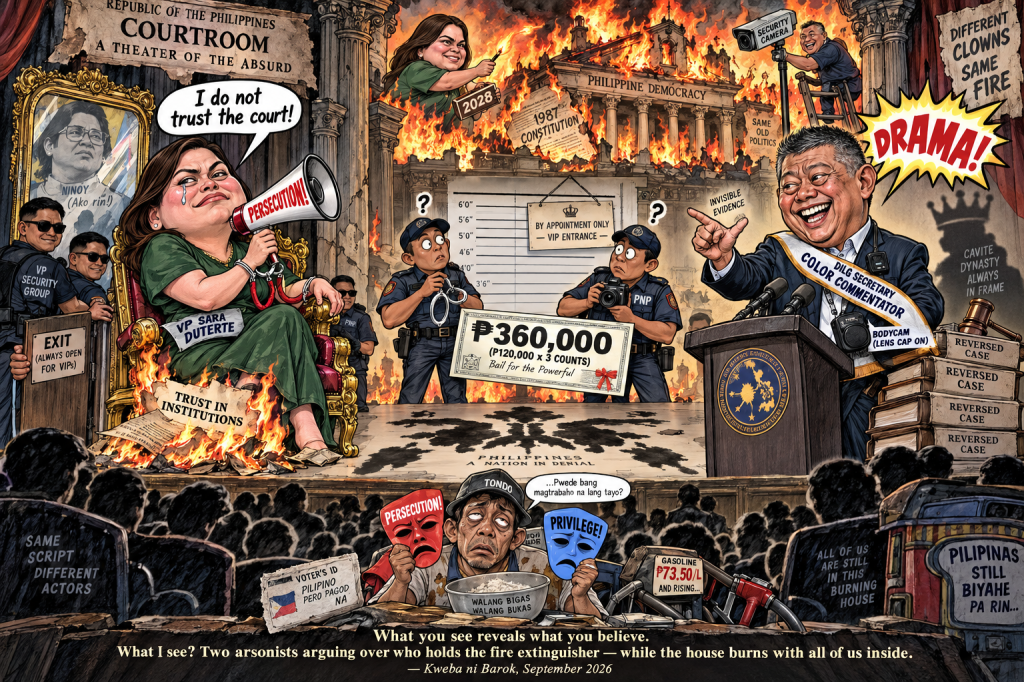
The Art of Reverse Victimology: Turning Your Accuser into the Accused Without Breaking a Sweat
By Louis ‘Barok‘ C. Biraogo — September 7, 2026
PART I: THE SETTING
In the grand theater of Philippine politics, where thespians outnumber statesmen and the 1987 Constitution of the Republic of the Philippines (1987 Constitution) is treated as a suggestion rather than a covenant, we have witnessed the most spectacular non-event of the decade.
Vice President Sara Duterte—scion of the Davao dynasty, presumptive 2028 frontrunner, and a woman whose mouth has a faster trigger than her father’s anti-drug campaign—was arrested. No, not arrested. Surrendered. No, not surrendered. Posted bail. Wait. What actually happened?
This, mga ka-kweba, is precisely the problem.
What happened on September 5, 2026, at Quezon City Regional Trial Court (RTC) Branch 98 depends entirely on which propaganda apparatus you subscribe to.
- The Marcos administration’s version: justice was served with dignity, professionalism, and restraint.
- The Duterte camp’s version: political persecution wrapped in a velvet glove, with surveillance, harassment, and state resources deployed against a woman who simply told the truth about wanting to behead the President.
Neither version tells the whole story. And both versions are insulting to anyone with functioning brain cells.
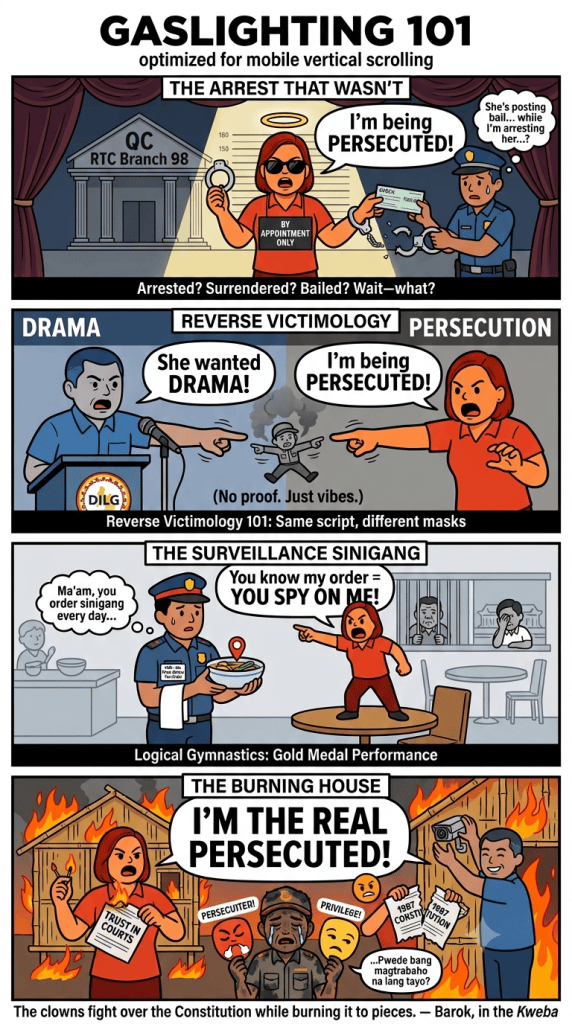
The Sara Duterte saga nobody understands, everyone argues about.
PART II: THE DRAMA ALLEGATION—REVERSE VICTIMOLOGY 101
Interior Secretary Jonvic Remulla, whose family has ruled Cavite politics longer than some Philippine governments have existed, has entered the theater himself. His allegation that Duterte’s camp “sought drama” by requesting handcuff and jail photos is a masterclass in political counter-narrative.
Let us examine the architecture:
- The Source: Criminal Investigation and Detection Group (CIDG) Chief Major General Robert Morico II claims the Vice Presidential Security and Protection Group initially told police that Duterte wanted to be incarcerated. Note the word: incarcerated. Not photographed. Not dramatized. Incarcerated.
- The Leap: From “wants to be jailed” to “wants handcuff photos for political theater”—this is an Olympic-sized leap. It requires believing that Duterte, whose political brand is built on tough-on-crime messaging, decided to cosplay as a victim of oppression.
- The Evidence: None. Zilch. Nada. Zero independently verified documentation. No written communication. No recording. No statement from Duterte’s lawyers confirming it. Just Remulla’s word, delivered with the confidence of a man who knows the media will repeat anything he says.
This is what forensic rhetoricians call “reverse victimology”—turning the accused into the accuser, the victim into the manipulator. Brilliant politics. Potentially complete fabrication.
But here’s the uncomfortable truth for Team Duterte: Your camp’s initial communication apparently did indicate a desire for incarceration. This is confirmed by police officials. Before you cry “fake news” at Remulla, ask your own security team why they thought a jail cell was a good idea for a sitting VP who was eligible for bail.
PART III: THE SURVEILLANCE CLAIM—LOGICAL GYMNASTICS
Duterte’s claim that Remulla’s admission—that police “knew her whereabouts”—proves surveillance is either intellectually dishonest or deeply ignorant of police work.
Remulla said the Philippine National Police (PNP) knew where Duterte was. Duterte concluded: “Therefore, I was under surveillance.”
This is the logical equivalent of saying: “The waiter knows I ordered sinigang, therefore the waiter has been watching me sleep.”
How might police know where a sitting Vice President is? Let me count the ways:
- She has a government security detail that coordinates with police.
- She is a public official with publicly known movements.
- Her advance team communicates with local authorities.
- She is the Vice President of the Republic.
However, Duterte has every right to demand: How did police know? Under what authority? For what purpose? Was there intelligence collection beyond legitimate warrant execution?
These are legitimate questions. The government has not answered them. Instead, Remulla has mocked Duterte’s fears, saying pressure is “affecting her perception.” This is gaslighting of the highest order—dismissing legitimate security concerns while claiming the moral high ground.
PART IV: THE MUGSHOT THAT NEVER WAS—EQUAL JUSTICE OR ELITE PRIVILEGE?
Now the most delicious part: The Missing Mugshot.
House prosecutor Terry Ridon has labeled the absence of a mugshot as “special treatment.” He’s not wrong.
The PNP Operational Procedures Manual is clear: arrested suspects undergo booking procedures, including “4R mug shots”—front, left, right, with identification board. This is not optional.
But here’s the catch: Duterte was never technically arrested by the PNP. She “voluntarily surrendered” directly to the court. Under Rule 113, Section 2, this is valid arrest. But it creates a procedural gray area the PNP seems to have exploited—or fumbled.
The Uncomfortable Questions:
- If Duterte “surrendered to the court,” why did police need to go to her residence?
- If she was technically arrested, why was there no booking?
- If there was no booking, was there actually an arrest?
- If there was no arrest, was there any legal consequence?
The government wants this both ways: Duterte was arrested (for optics of accountability) but wasn’t booked (for optics of dignity). This is having your lechon and eating it too.
For the record: A mugshot is not a humiliation ritual. It is an administrative record. Treating it as an optional courtesy for the powerful is precisely the elite privilege that Duterte’s “anti-imperialist” base should oppose.
PART V: THE CONSTITUTIONAL HOUSE OF CARDS
Let us be clear: The warrant was lawfully issued. QC RTC Branch 98 personally determined probable cause. Unless you believe every judge in the Philippines is a Marcos puppet, this is due process in action.
But probable cause is not proof of guilt. The standard is “well-founded belief”—vastly below “proof beyond reasonable doubt.”
Duterte’s substantive defense has genuine legal merit:
- Conditional Nature: Her November 2024 remarks—”If I am killed, kill BBM”—can be read as conditional threats. Act No. 3815 (Revised Penal Code) distinguishes between conditional and unconditional grave threats.
- Mens Rea: The Supreme Court’s Gregory Israel v. People of the Philippines (Israel v. People) (2025) emphasized that grave threats require “the deliberate purpose required by the offense.” A political rant, no matter how violent, may not rise to this standard.
- Political Rhetoric Context: If every politician who threatened violence were prosecuted, the RTC would need a building the size of Araneta Coliseum.
However, the prosecution has strong counterarguments:
- Duterte allegedly said she had already spoken with an assassin—not that she would if she were killed. That detail, if proven, destroys the conditionality defense.
- The threats targeted specific individuals: Marcos, First Lady Liza Araneta-Marcos, and Speaker Martin Romualdez.
- The statement was public. Under People of the Philippines v. Juvenal Azurin y Blanquera (Azurin v. People), the crime is consummated when the threat reaches the threatened person. Marcos obviously knows.
This is a genuinely contestable case. Both sides have legitimate arguments. That fact alone should humble both Remulla and Duterte—but humility is not a growth industry in Philippine politics.
PART VI: THE POLITICAL MATHEMATICS
What this is actually about: 2028.
Sara Duterte’s presidential ambitions face two existential threats:
- Impeachment Conviction: A guilty verdict permanently bars her from public office. This is the nuclear option.
- Criminal Conviction: Even a minor conviction creates the “convicted criminal” label opponents will weaponize.
The Marcos administration’s strategy is transparent: death by a thousand legal cuts. Impeachment (political), criminal case (judicial), constant media narrative (psychological)—all designed to erode Duterte’s viability without creating the martyrdom effect of outright political imprisonment.
This is brilliant statecraft. It is also profoundly dangerous.
The Martyrdom Risk: Every accusation, every warrant, every “drama” allegation pushes Duterte’s base into a defensive crouch. The administration’s onslaught risks creating exactly the martyr narrative that could sweep her into Malacañang.
The Consolidation Imperative: The 2025 midterms are over. The question is no longer whether the Marcos coalition will secure a supermajority—it is whether they did, and whether they can now hold votes as the impeachment trial unfolds. Conviction requires 16 of 24 senators. With three Duterte allies sidelined (dela Rosa, Estrada, Marcoleta), only 21 senators remain in play—making the administration’s path mathematically easier, but politically volatile. The real imperative now is coalition discipline, not electoral arithmetic. The battle has shifted from winning seats to holding votes.
The Wild Card: Rodrigo Duterte sits in The Hague, facing ICC prosecution. His daughter faces prosecution and impeachment. The family’s political brand is being tested like never before.
PART VII: THE REMULLA QUESTION
What motivates Jonvic Remulla?
This is a man whose family has ruled Cavite for generations. He is not a neutral actor. His statements about Duterte—”sanay kasi sila sa shortcut” (“they’re used to shortcuts”)—are not law enforcement communications. They are political attacks.
The question the media is not asking: Why is the Department of the Interior and Local Government (DILG) Secretary—whose department oversees the PNP—publicly litigating the facts of an ongoing criminal case? Why is he commenting on the motives of a defendant? Why alleging “drama” without presenting evidence?
Under Republic Act No. 6713 (The Code of Conduct and Ethical Standards for Public Officials and Employees), officials must uphold “justness and sincerity” and avoid “undue patronage.” Remulla’s conduct may not violate the letter of the law, but it certainly violates its spirit.
The DILG Secretary is not running for office. His job is to ensure the PNP operates professionally, not to provide color commentary on political opponents.
Unless, of course, his job is actually to provide color commentary. In which case, the public should know.
PART VIII: WHAT SHOULD HAPPEN NEXT
For the Marcos Administration:
- Release everything. The warrant, booking records, bodycam footage, police logs, coordination with VP Security Group. If your conduct was professional, prove it. If you cannot prove it, resign.
- Stop the rhetoric. Remulla’s “drama” commentary serves no legitimate law enforcement purpose. It undermines the professional image you claim to defend.
- Let the criminal case proceed without political interference. If Duterte is guilty, convict her. If not, acquit. Anything else is persecution.
For the Duterte Camp:
- Release your surveillance evidence. You claim to have “documents.” Produce them. If you have no proof, stop making the allegation.
- Stop the Ninoy comparisons. Ninoy Aquino returned from exile to confront a dictatorship, knowing it might cost him his life. Sara Duterte is posting bail in a court where she has every procedural advantage. These are not the same thing.
- Trust the legal process. You claim to believe in the rule of law. Then let the law work. Exercise that right like a democrat, not a victim.
PART IX: THE VERDICT
This controversy is a Rorschach test for Philippine democracy. What you see reveals what you believe about law, politics, and power.
If you see persecution: You believe the Marcos administration is using state institutions to destroy political rivals.
If you see privilege: You believe Duterte expects special treatment and attempted to manufacture a victim narrative.
If you see procedural gray areas: You are correct. This case exists in a constitutional fog—where voluntary surrender meets arrest warrants, where security accommodations meet equal protection, where political rhetoric meets criminal law.
What I see is more troubling: a democracy where the line between law enforcement and political warfare has entirely dissolved. Where a Vice President’s arrest is simultaneously a judicial proceeding and a propaganda opportunity.
This is not the rule of law. It is the rule of lawyers. And in the Philippines, lawyers are political operatives with better wardrobes.
POSTSCRIPT
The most revealing moment was not the warrant, the bail, or the bodycam. It was Duterte’s statement that she does not trust the court or the police.
Not “I disagree with the judge’s ruling.” Not “I question the evidence.” Not “I will appeal.”
“I do not trust the court and the police.”
This is a sitting Vice President expressing no confidence in the institutions she swore to uphold. Whatever one thinks of Duterte, this statement is a repudiation of the constitutional order she serves.
Perhaps that is the point. Perhaps Duterte believes the entire system is corrupt, so distrust is the only rational position. Perhaps she is right.
But if the Vice President does not trust the courts, why should ordinary Filipinos? If the Vice President does not trust the police, why should a jeepney driver in Tondo? If institutions cannot be trusted to treat the powerful fairly, what hope is there for the powerless?
The answer to abuse of power is not to abandon institutions. It is to demand they work.
The Duterte strategy—undermine faith in every institution she cannot control—is the strategy of an authoritarian, not a democrat. It is burning down a house to get rid of termites.
The Marcos strategy—use institutions to weaken a political rival—is the strategy of those who have learned nothing from history. It is installing a security camera in a house already on fire.
The tragedy is that both are playing with matches in a house made of dry bamboo.
This is Barok, in the Kweba, watching the circus. The clowns are fighting over who gets to hold the Constitution while both are tearing it to pieces.
–ABANGAN–
Key Citations
A. Legal & Official Sources
- The 1987 Constitution of the Republic of the Philippines. Official Gazette of the Republic of the Philippines, 1987, http://www.officialgazette.gov.ph/constitutions/1987-constitution/.
- Act No. 3815. An Act Revising the Penal Code and Other Penal Laws (Revised Penal Code). 1930, lawphil.net/statutes/acts/act_3815_1930.html.
- Republic Act No. 6713. An Act Establishing a Code of Conduct and Ethical Standards for Public Officials and Employees. 1989, http://www.officialgazette.gov.ph/1989/02/20/republic-act-no-06713/.
- Revised Rules of Criminal Procedure, Rule 113, Section 2. Supreme Court of the Philippines, lawphil.net/courts/supreme/rc/rc_110-127_crim.html.
- Revised Philippine National Police Operational Procedures. Philippine National Police, Directorate for Operations, http://www.policinglaw.info/assets/downloads/Revised_Philippine_National_Police_Operational_Procedures.pdf.
- Israel, Gregory v. People of the Philippines. G.R. No. 265736, Supreme Court of the Philippines, 19 Nov. 2025, elibrary.judiciary.gov.ph/thebookshelf/showdocs/23/70307.
- People of the Philippines v. Juvenal Azurin y Blanquera. G.R. No. 249322, Supreme Court of the Philippines, 14 Sept. 2021, elibrary.judiciary.gov.ph/thebookshelf/showdocs/23/67692.
B. News Reports
- Corrales, Nestor, and Eloisa Lopez. “Philippine VP Duterte Posts Bail after Arrest Order for Alleged Grave Threats.” Reuters, 5 Sept. 2026, http://www.reuters.com/world/asia-pacific/philippine-vp-duterte-posts-bail-after-arrest-order-alleged-grave-threats-2026-09-05/.
- Rita, Joviland. “VP Sara Camp Receives Arrest Warrant over Grave Threats, Plans Bail ASAP – DILG.” GMA News Online, GMA Network, 4 Sept. 2026, http://www.gmanetwork.com/news/topstories/nation/1001147/vp-sara-camp-receives-arrest-warrant-over-grave-threats-plans-bail-asap-dilg/story/.
- Ramirez, Renalyn. “Remulla: Sara Duterte Camp Sought ‘Drama’ with Handcuff, Jail Photos.” Philstar.com, 7 Sept. 2026, http://www.philstar.com/headlines/2026/09/07/2554623/remulla-sara-duterte-camp-sought-drama-handcuff-jail-photos.
- Porcalla, Delon. “No VP Sara Mugshots? Ridon Hits ‘Special Treatment.’” Philstar.com, 7 Sept. 2026, http://www.philstar.com/headlines/2026/09/07/2554499/no-vp-sara-mugshots-ridon-hits-special-treatment.
- “Why Was Sara Duterte Allowed to Post Bail on a Saturday? No Mugshot Taken?” Rappler, 7 Sept. 2026, http://www.rappler.com/philippines/reasons-sara-duterte-allowed-post-bail-saturday-no-mugshot/.
- “Ang Hirap Maging Mahirap”: The PAO Scandal That Proves Government Contempt Is Nothing New
- “Far-Off” My Axx: Malacañang’s Claire Castro Drowns in Her Own Legal Gaslighting
- “Forthwith” to Farce: How the Senate is Killing Impeachment—And Why Enrile’s Right (Even If You Can’t Trust Him)

- “HINDI AKO NAG-RESIGN!”

- “I Know Nothing”: Baste Duterte’s Amnesia Defense Meets ₱33M in GenCorp Contracts
- “I’m calling you from my new Globe SIM. Send load!”

- “Mahiya Naman Kayo!” Marcos’ Anti-Corruption Vow Faces a Flood of Doubt

- “Manageable” Debt, Unmanageable Lies: DBM’s ₱21 Trillion Fairy Tale
- “Meow, I’m calling you from my new Globe SIM!”

- “Natrabaho”: One Word, One Ombudsman, and a Judiciary on Trial
- “No Special Jail for Crooks!” Boying Remulla Slams VIP Perks for Flood Scammers

- “Philippine-Controlled” or Yankee Gas Station? The Davao Fuel Depot Farce Exposed




Leave a comment