Regulatory Capture in Real Time: The CPA’s Own Rules, Ignored
By Louis ‘Barok‘ C. Biraogo — September 11, 2026
LET me tell you something about port regulation in the Philippines. It’s where the money is. It’s where the power is. And apparently, it’s where the rules go to die.
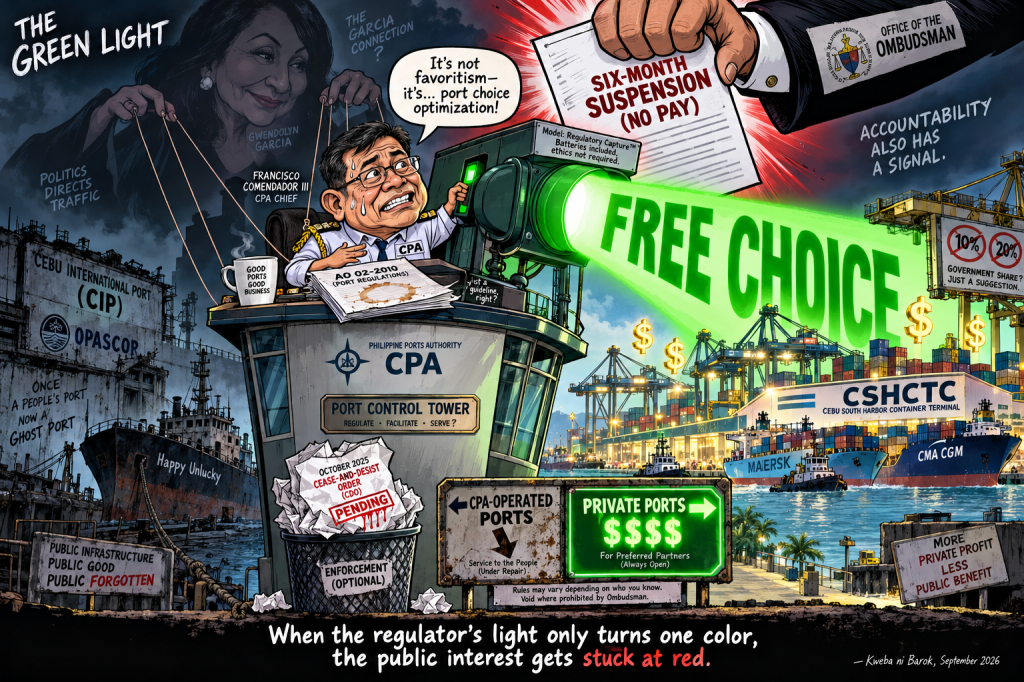
The Office of the Ombudsman just dropped a six-month preventive suspension on Francisco C. Comendador III, General Manager of the Cebu Port Authority (CPA). If you’re not paying attention, you should be. What’s happening in Cebu isn’t a bureaucratic squabble—it’s a masterclass in how regulatory agencies get captured while the public picks up the tab.
The Rule That Seems Pretty Clear
Administrative Order No. 02-2010 (Omnibus Policy and Guidelines on the Development, Construction and Operation of Private Ports within the Territorial Jurisdiction of the Cebu Port Authority) isn’t Shakespearean in its ambiguity. The CPA’s own policy says private commercial ports may accommodate vessels only in cases of “spill-over demand, emergency, necessity, or congestion” at CPA-operated ports.
Memorandum Circular No. 04 from 2012 clarified further: private ports catering to third-party cargo are commercial. Government share must be collected—10% from domestic cargoes, 20% from foreign. And “Collection of the government share shall be a prerequisite for clearance of vessels as no port clearance shall be granted unless and until all port charges and government share are paid.”
We have a rule. We have a clarification. This isn’t rocket science. This is “follow your own regulations 101.”

The Letter That Changed Everything
According to the Oriental Port and Allied Services Corporation (OPASCOR)—operating cargo-handling at the Cebu International Port (CIP) under a contract valid until 2038—something changed.
Comendador initially rejected a request from Maersk Filipinas Inc. for its vessel, the Happy Lucky, to dock at Cebu South Harbor and Container Terminal Corporation (CSHCTC), a private commercial port—citing the absence of emergency, necessity, or congestion.
Good. That’s following the rules.
But on June 4, 2024, Comendador reportedly sent a letter to former Cebu Governor Gwendolyn Garcia stating that shipping companies and vessels could “freely choose their preferred port” and that private commercial ports could accept vessels provided they were suitable.
Wait. What?
We went from “no, there’s no emergency” to “everyone can dock wherever they want.” The Ombudsman found this evidence “strong” enough to warrant preventive suspension. Looking at the documentary trail, it’s hard to disagree.
Ships Don’t Lie
Following that letter, OPASCOR claims major shipping lines—including Maersk and CMA CGM—transferred operations from CIP to CSHCTC.
Result? Declining cargo throughput at CIP. Declining yard utilization. Declining vessel calls. Reduced CPA revenues. Adverse effects on OPASCOR’s business.
Correlation isn’t causation. Shipping lines make commercial decisions based on berth availability, turnaround time, port charges, crane productivity. But the letter explicitly told them they could move. That’s not a subtle policy shift. That’s a green light.
The Cease-and-Desist Order That Wasn’t Enforced
OPASCOR also alleged CSHCTC had violations involving revenue remittances and cargo-handling fees. A CPA cease-and-desist order was issued in October 2025 against CSHCTC over expansion beyond its permit scope.
That order “had not been fully implemented.”
Let me get this straight. The CPA issues a cease-and-desist order. The General Manager—responsible for enforcing it—doesn’t fully implement it. The private port continues operating beyond its permit scope?
If true, we’re not talking about policy disagreement. We’re talking about gross neglect of duty.
The Ombudsman’s Authority: Broad, But Not Unlimited
Section 24 of Republic Act No. 6770 (The Ombudsman Act of 1989) allows preventive suspension when:
- The evidence of guilt is strong; AND
- At least one of the following exists:
- The charge involves dishonesty, oppression, grave misconduct, or neglect of duty;
- The charge would warrant removal from service; OR
- The respondent’s continued stay may prejudice the case.
The Ombudsman found both requirements met. The evidence was “strong at this time.” The charges—grave misconduct and gross neglect—could warrant dismissal under the 2025 Rules on Administrative Cases in the Civil Service (2025 RACCS).
The Ombudsman also found Comendador’s continued stay “could allow him to influence witnesses or tamper with evidence relevant to the case, given his powers and authority as CPA general manager.”
That’s not trivial. As General Manager, Comendador controls personnel, records, communications, operational decisions. He could make it very difficult for investigators to get a clear picture.
The suspension is without pay, “shall not exceed six months,” and is “immediately executory and its implementation will not be interrupted by any motion, appeal or petition filed by Comendador unless otherwise ordered by the Ombudsman or a competent court.”
That’s the law. It exists for a reason.
The Defense: Policy Discretion or Something More?
Comendador said he will comply. “In compliance with the order of the Ombudsman and to ensure the integrity and impartiality of the investigation, I will abide by the directive. I am currently consulting with my legal counsel to determine the appropriate legal remedies available to me.”
Smart move. Disobeying an Ombudsman suspension would create new problems.
His most charitable defense? He genuinely believed AO 02-2010 was outdated. Maybe he thought allowing shipping lines to choose their port would improve efficiency. That’s a legitimate policy position. It’s not, however, a legitimate basis for unilaterally suspending a regulation the Cebu Port Commission adopted and clarified.
If Comendador disagreed, the proper remedy was to propose an amendment to the Commission. Not to issue a letter saying, “Actually, shipping lines can do whatever they want.”
The Garcia Connection: Politics as Usual?
The June 4, 2024 letter was addressed to Garcia—described as “former Cebu governor.” Why write to a former governor about port policy?
Garcia is a political heavyweight. In April 2024—two months before the letter—she sided with the CPA in a territorial dispute with Cebu City. CPA personnel had been blocked from continuing a wharf extension by City officials claiming the project lacked building permits. Garcia called out the City Government for “disrespecting and ignoring the territorial jurisdiction of the Cebu Port Authority.”
At that press conference? Comendador himself, saying the CPA was preparing legal action against City Hall.
So we have a General Manager publicly aligned with Garcia in April 2024. Then in June 2024, he writes to Garcia saying shipping lines can freely choose their ports—benefiting CSHCTC, a private port.
I’m not saying there’s a quid pro quo. I’m saying the timing is interesting. Investigators should be asking questions.
The OPASCOR Factor: Not Exactly Disinterested
OPASCOR operates cargo-handling at CIP under a contract until 2038. When cargo moves to CSHCTC, OPASCOR loses business. Of course they’d complain.
That doesn’t mean their complaint lacks merit. A private company can legitimately report government misconduct. But investigators should be clear-eyed about motivations. This isn’t just about enforcing the law. It’s about protecting market position.
Regulatory Capture in Real Time
The CPA has a dual role: operates CIP and regulates private ports including CSHCTC. Inherent conflict of interest.
When the General Manager writes a letter saying private ports can accept any vessels regardless of the regulatory framework, he’s potentially undermining the government port he’s supposed to operate. When a cease-and-desist order isn’t fully enforced, that’s a signal the rules don’t apply equally.
The Ombudsman’s suspension is necessary to preserve the investigation’s integrity. But it’s not the end. The real question: can the CPA’s regulatory framework survive contact with commercial and political pressure?
What Comes Next: Follow the Money
The six-month suspension gives investigators time. Here’s what they should dig into:
- First, the June 4, 2024 letter. What exactly did it say? Who drafted it? Was it reviewed by legal counsel? Did the Commission authorize it? If not, why did Comendador send it?
- Second, the October 2025 cease-and-desist order. What did it require? Why wasn’t it enforced? Who decided not to enforce it?
- Third, revenue records. How much did CPA lose when shipping lines moved? How much government share should have been collected from CSHCTC? Was it?
- Fourth, relationships. What’s the connection between Comendador and CSHCTC? Between Comendador and Garcia? Any financial interests, family connections, political alliances?
- Fifth, causation. Did the letter actually cause the transfers? What do shipping lines say?
These questions determine whether this is grave misconduct or simply policy disagreement.
The Verdict (So Far)
Based on what’s publicly known, the Ombudsman’s decision looks legally sound.
The evidence of policy reversal—from rejecting Maersk to allowing “free choice”—is documented. The regulatory framework allegedly violated is clear. Economic consequences are measurable. Risk of evidence tampering is real.
But suspension is not conviction. The Ombudsman explicitly said the order “does not resolve the merits of the administrative complaint.” Comendador will present his defense.
If he shows his letter was good-faith interpretation of ambiguous regulation, rather than deliberate departure from clear rule, the case weakens. Grave misconduct requires more than error of judgment. It requires corruption, clear intent to violate law, or flagrant disregard of established rules.
The burden is on the Ombudsman to prove not just that Comendador got it wrong, but that he knew he was getting it wrong—and did it anyway.
The Real Stakes
This case matters beyond Cebu. It tests whether the Ombudsman can hold high-ranking officials accountable for regulatory decisions favoring private interests over public ones.
It exposes inherent tensions where government both operates ports and regulates them.
And if allegations are true, it shows how easy it is for one official to undermine a regulatory framework designed to protect public revenue and ensure fair competition.
The Ombudsman has taken the first step. Now we wait to see whether the investigation justifies the suspension—or exonerates the suspended.
Either way, the public deserves to know what happened at the Cebu Port Authority. Ports are public infrastructure. Revenues are public funds. Rules are supposed to serve the public interest.
Not the interests of any shipping line, private port operator, or political patron.
Louis ‘Barok’ C Biraogo is the author of the Kweba ni Barok blog, where he writes about law, politics, and governance in the Philippines. He has no financial interest in any port, shipping line, or cargo-handling company. He just wants the rules to be followed.
Key Citations
A. Legal & Official Sources
- Cebu Port Authority. Administrative Order No. 02, s. 2010. Omnibus Policy and Guidelines on the Development, Construction and Operation of Private Ports within the Territorial Jurisdiction of the Cebu Port Authority. 16 July 2010, elibrary.judiciary.gov.ph/thebookshelf/showdocs/10/55843.
- Republic Act No. 6770. An Act Providing for the Functional and Structural Organization of the Office of the Ombudsman, and for Other Purposes. 17 Nov. 1989, lawphil.net/statutes/repacts/ra1989/ra_6770_1989.html.
- Civil Service Commission. 2025 Rules on Administrative Cases in the Civil Service. CSC Memorandum Circular No. 12, s. 2025 / CSC Resolution No. 2500357, 30 Apr. 2025, csc.gov.ph/phocadownload/userupload/irmo/mc/2025/MC%20No.%2012%20s.%202025.pdf.
- Office of the Ombudsman. Official Website. http://www.ombudsman.gov.ph/.
- Cebu Port Authority. Official Website. http://www.cpa.gov.ph.
B. News Reports
- Inso, Futch Anthony. “CPA GM Commendador: I Will Comply with Ombudsman Suspension Order.” Cebu Daily News, Inquirer, 9 Sept. 2026, cebudailynews.inquirer.net/765055/cpa-gm-commendador-i-will-comply-with-ombudsman-suspension-order.
- Palaubsanon, Mitchelle L. “Ombudsman Suspends CPA Chief.” The Freeman, Philstar, 9 Sept. 2026, http://www.philstar.com/the-freeman/cebu-news/2026/09/09/2555026/ombudsman-suspends-cpa-chief.
- “Ombudsman Suspends Cebu Port Authority GM.” PortCalls Asia, 9 Sept. 2026, portcalls.com/ombudsman-suspends-cebu-port-authority-gm/.
- Padronia, Earl Kim H. “Gwen Sides with CPA on Territorial Row.” SunStar Cebu, 8 Apr. 2024, http://www.sunstar.com.ph/cebu/gwen-sides-with-cpa-on-territorial-row.
- Virador, Cherry Ann. “Cebu Port Authority Chief Suspended over Neglect of Duty Allegations.” SunStar Cebu, 9 Sept. 2026, http://www.sunstar.com.ph/cebu/cebu-port-authority-chief-suspended-over-neglect-of-duty-allegations.

- “Far-Off” My Axx: Malacañang’s Claire Castro Drowns in Her Own Legal Gaslighting

- “Forthwith” to Farce: How the Senate is Killing Impeachment—And Why Enrile’s Right (Even If You Can’t Trust Him)

- “HINDI AKO NAG-RESIGN!”

- “I’m calling you from my new Globe SIM. Send load!”

- “Mahiya Naman Kayo!” Marcos’ Anti-Corruption Vow Faces a Flood of Doubt

- “Manageable” Debt, Unmanageable Lies: DBM’s ₱21 Trillion Fairy Tale

- “Meow, I’m calling you from my new Globe SIM!”

- “Natrabaho”: One Word, One Ombudsman, and a Judiciary on Trial

- “No Special Jail for Crooks!” Boying Remulla Slams VIP Perks for Flood Scammers

- “Philippine-Controlled” or Yankee Gas Station? The Davao Fuel Depot Farce Exposed

- “PLUNDER IS OVERRATED”? TRY AGAIN — IT’S A CALCULATED KILL SHOT

- “Several Lifetimes,” Said Fajardo — Translation: “I’m Not Spending Even One More Day on This Circus”





 KWEBA ni BAROK
Leave a comment