The Audit Trail is Real. The Allegation is a Mirage.
By Louis ‘Barok‘ C. Biraogo — September 9, 2026
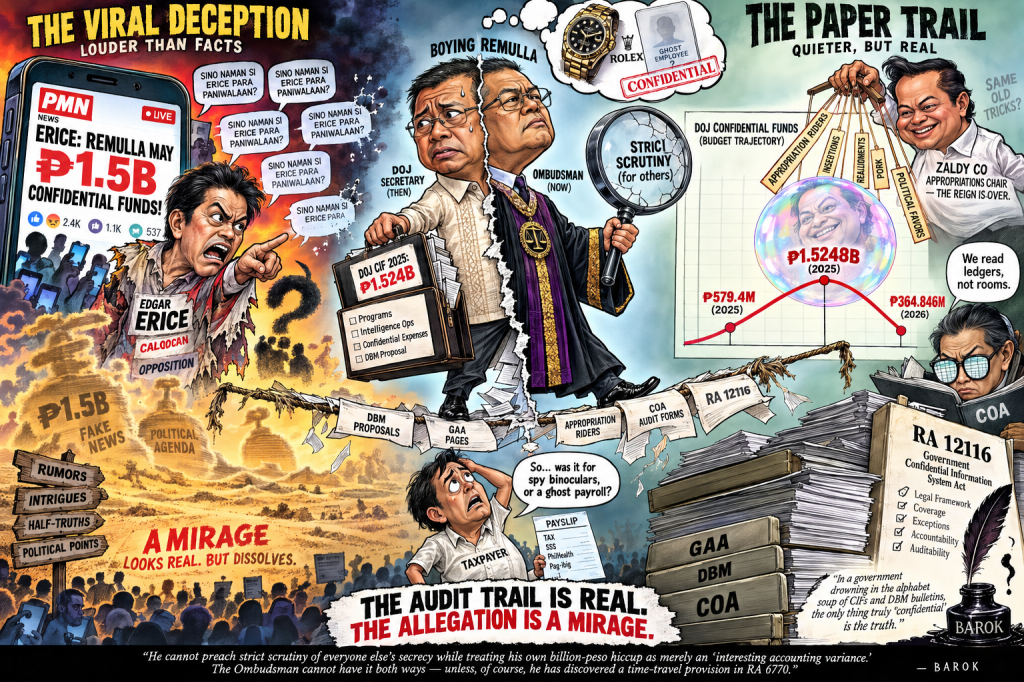
THERE is a certain brilliance to the Pinoy Media Network (PMN) social media post that has set Philippine political discourse ablaze. It is not the brilliance of journalistic integrity, mind you, but the dark alchemy of virality. It takes a legitimately complex, document-heavy audit question and transmutes it into a single, gut-punching headline: “Erice, ibinulgar na may 1.5 Billion Confidential Funds umano si Ombudsman Boying Remulla.”
In the hallowed halls of disinformation, this is a masterclass. The post’s comment section asks the most pertinent question in modern Philippine politics: “Sino naman si Erice para paniwalaan?” (Who is Erice to be believed?). And therein lies the tragicomedy. We are so obsessed with the pedigree of the accuser—an opposition figure with a bruised ego and a score to settle—that we risk ignoring the forensic anomaly of the accusation itself.
Let us strip away the political theater and look at the receipts, shall we? Because in the curious case of the Ombudsman’s allegedly vanishing funds, the truth is far stranger, and far more intellectually insulting, than a simple accusation of theft.
Pinoy Media Network (PMN) social media post

The Anatomy of a Viral Deception
The first sin of the PMN post is chronological slander. It calls Boying Remulla the “Ombudsman” in the context of a fund anomaly that occurred while he was the Secretary of Justice. Unless the good Ombudsman has discovered a time-travel provision buried deep within Republic Act No. 6770 (The Ombudsman Act of 1989), this is administratively impossible. He did not carry the Department of Justice (DOJ) budget into the Ombudsman’s office in a briefcase like a political dowry.
The second, and more egregious, sin is the conflation of an agency appropriation with a personal fund. This is the intellectual equivalent of saying that because you manage a branch of a bank, the deposits in the vault are your spending money for the weekend. The official Republic Act No. 12116 (General Appropriations Act or GAA) for Fiscal Year 2025 does show a staggering ₱1.524846 billion line item for DOJ “Confidential Expenses.” That is not fake news. That is a fact. But to claim Ombudsman Remulla “has” this money is to misunderstand how the Commission on Audit (COA) works. If even a single peso of that had gone into a ghost payroll or a Rolex, the COA auditors—who are notoriously unable to read the room but excellent at reading ledgers—would have had a field day.
The Explosive Elephant in the Room: The Budget Trajectory
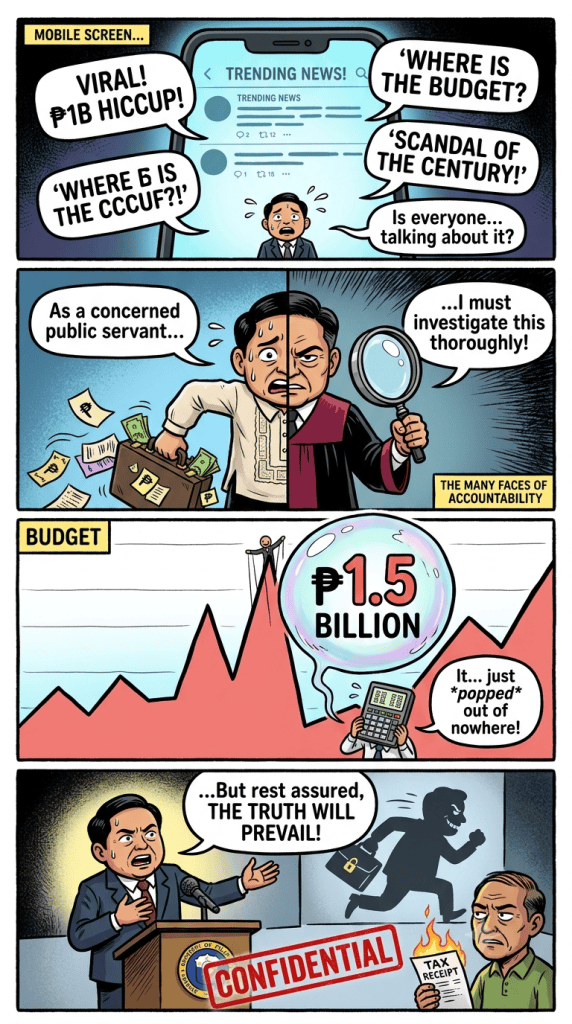
Despite the boorish framing of the social media post, the underlying allegation from former Caloocan Rep. Edgar Erice cannot be dismissed with a lazy wave of the hand. Research into the budget documents reveals a sequence of events that should make every taxpayer’s stomach clench, not necessarily with proof of corruption, but with the certainty of systemic absurdity.
According to our research of the Department of Budget and Management (DBM) proposals, the DOJ’s initial proposed Confidential and Intelligence Funds (CIFs) for 2025 was a relatively modest ₱579.4 million. Yet, by the time the ink dried on the final GAA, the enacted figure had ballooned to ₱1.5248 billion. That is an increase of nearly ₱1 billion—almost a billion pesos added to a line item that is, by legal definition, shielded from public scrutiny.
This is the “smoking gun” that Erice is pointing to, and frankly, he should keep pointing. Where did this money come from? It came during the reign of the infamous “pork” master, Zaldy Co, as Appropriations Chair. The 2026 budget documents even reveal a comedic snap-back: the proposed DOJ confidential funds for 2026 plummeted back down to around ₱364.846 million. This creates a one-year bubble of massive cash in 2025 that vanishes the following year.
This is not evidence of theft; it is evidence of a budget process that operates like a fever dream. It is a “billion-peso hiccup.” Did the DOJ suddenly need an extra billion pesos to spy on people in 2025, only to realize in 2026 that they had overestimated the cost of binoculars and burner phones? The unexplained, parabolic spike in the budget demands an audit trail. If it was for legitimate counter-intelligence or witness protection, the public deserves to know the line in the GAA that justified it. If it was a covert “insertion” to create a slush fund, that is a constitutional scandal of the highest order.
The Irony of the Ombudsman’s Defense
Here is where the narrative takes an interesting turn. Boying Remulla is no longer just a politician; he is the sitting Ombudsman—the apex guardian of anti-corruption. He currently holds the sword of Damocles over people like Zaldy Co and, potentially, Vice President Sara Duterte regarding her own suspect CIF usage.
Ombudsman Remulla has responded to the viral storm by defending his office’s proposed ₱51.4 million confidential fund for 2027, arguing it is a “drop in the bucket.” He has a point. It is pocket change compared to the ₱1.5 billion anomaly he oversaw at the DOJ—an anomaly that, curiously, materialized during the watch of then-Appropriations Chair Zaldy Co, the same man now facing plunder charges and reportedly hiding somewhere in Europe. Congress appropriated it, yes—but which Congress, and at whose discretion? Remulla didn’t pocket it. But someone with a gavel and a pork barrel might have known exactly where it was going.
The satirical irony is gentler than it first appears: the man tasked with auditing everyone else’s secrecy now finds his own former agency’s budget under the microscope. But this is not hypocrisy—it is the natural consequence of holding high office.
He cannot preach strict scrutiny of confidential fund abuses while expecting his own former agency’s budget to escape similar examination. That is fair. But it is equally fair to note that examining a budget is not the same as proving a crime.
The ₱1.5 billion figure is real. The spike is documented. The Zaldy Co connection is alleged but unproven. What Remulla deserves is not a presumption of guilt, but the same benefit of the doubt he extends to others: due process and a fair look at the paper trail.
If the documents show a lawful appropriation and proper expenditure, then the Ombudsman’s defense is not ironic at all—it is vindicated. And Erice’s billion-peso hallucination remains just that: a hallucination.
The Investigative Reality
Let us be analytical about the legal possibilities. The PMN post claims Erice said Remulla personally requested ₱1 billion plus another ₱150 million from Zaldy Co. That accusation is currently unproven. There are no leaked text messages, no whistleblower affidavits, and no signed memos presented in the public sphere. Erice is asking the public to connect the dots based on the timeline.
However, under the Supreme Court’s rulings in Araullo v. Aquino and the principles of Republic Act No. 3019 (the Anti-Graft and Corrupt Practices Act), an increase in an appropriation is not inherently illegal. Congress has the power of the purse. The crime lies in the “quid pro quo”—the manifest partiality or evident bad faith in the disbursement. The problem is, by definition, confidential funds lack the granular reporting required for standard line items.
This is the investigative black hole that the social media post ignores. It is impossible to tell from the outside if the ₱1.5 billion was used to fight the drug war, protect witnesses, or line the pockets of bureaucrats. The social media post wants immediate conviction; the legal reality demands a tedious, forensic excavation of the paper trail between the DBM, the DOJ, and Congress.
The Verdict on the Noise
Barok’s final assessment: The PMN post is materially misleading because it attributes an agency anomaly to a specific person in the wrong capacity. It is a hit piece dressed in the clothes of breaking news.
But let us not throw the baby out with the bathwater of satire. The underlying numbers are deeply suspicious. The “Remulla billion” is a real fiscal artifact that deserves formal investigation, not just Facebook comments. Edgar Erice may be a biased partisan hack, but he has stumbled onto a legitimate question: Why did the DOJ’s confidential budget explode by a billion pesos for one single year?
If Ombudsman Remulla wants to be the champion of accountability, he should order a forensic COA audit of the FY 2025 DOJ confidential funds himself and release the aggregate findings. If he won’t, the question lingers like the smell of smoke after a fire: was this a legitimate war chest for justice, or merely the biggest “ghost employee” payroll in the history of the Department of Justice?
In a government drowning in the alphabet soup of CIFs and DBM bulletins, the only thing truly “confidential” is the truth.
Key Citations
A. Legal & Official Sources
- The 1987 Constitution of the Republic of the Philippines. Official Gazette of the Republic of the Philippines, 1987, http://www.officialgazette.gov.ph/constitutions/1987-constitution/.
- The 1987 Constitution of the Republic of the Philippines, Article VI (Legislative Department). Official Gazette of the Republic of the Philippines, http://www.officialgazette.gov.ph/constitutions/the-1987-constitution-of-the-republic-of-the-philippines/the-1987-constitution-of-the-republic-of-the-philippines-article-vi/.
- Republic Act No. 6770. An Act Providing for the Functional and Structural Organization of the Office of the Ombudsman, and for Other Purposes (The Ombudsman Act of 1989). 17 Nov. 1989, lawphil.net/statutes/repacts/ra1989/ra_6770_1989.html.
- Republic Act No. 3019. Anti-Graft and Corrupt Practices Act. 17 Aug. 1960, http://www.officialgazette.gov.ph/1960/08/17/republic-act-no-3019/.
- Republic Act No. 12116. General Appropriations Act, Fiscal Year 2025 (Department of Justice, Confidential Expenses). Department of Budget and Management, http://www.dbm.gov.ph/wp-content/uploads/GAA/GAA2025/VolumeIA/DOJ/A.pdf.
- Republic Act No. 12116. General Appropriations Act, Fiscal Year 2025, General Provisions (Confidential Funds). Department of Budget and Management, http://www.dbm.gov.ph/wp-content/uploads/GAA/GAA2025/VolumeIB/GENPRO/GENPRO.pdf.
- Araullo v. Aquino III. G.R. No. 209287, Supreme Court of the Philippines, 1 July 2014, lawphil.net/judjuris/juri2014/jul2014/gr_209287_2014.html.
B. News Reports
- “Why Did DOJ’s Confidential Funds Balloon by Nearly Tenfold in 2025?” Rappler, 2026, http://www.rappler.com/philippines/explanation-department-justice-2025-confidential-funds-balloon-tenfold/.
- “Erice: Remulla Sought P1.15B DOJ Confidential Funds from Zaldy Co.” One News PH / Political Beat, 12 Aug. 2026, http://www.youtube.com/watch?v=lZkPx8x4Slg.

- ₱9 Billion in ‘Savings’? DILG’s Fire Truck Deal Smells Like Smoke

- ₱8B BBM Pork: CCTV for Every Captain’s Kumpare?

- ₱8.9 Billion, 331 Ghost Police Stations: The TIKAS Scandal Explained

- ₱8.4 Billion, 42,000 Barangays, 1 Election: The “Bawat Barangay Makikinabang” Vote-Buying Masterclass

- ₱75 Million Heist: Cops Gone Full Bandit

- ₱6.77B Ghost Haunts Duterte: RTC Dismisses Mans Carpio’s Desperate Plea
- ₱6.77 Billion and Zero Cash: The Sara Duterte SALN Math That Doesn’t Add Up

- ₱6.7-Trillion Temptation: The Great Pork Zombie Revival and the “Collegial” Vote-Buying Circus

- ₱58.53B, Zero Receipts: The LGSF Pork Barrel Nobody Wants to Name
- ₱53 Million Man Tells ₱695-a-Day Workers to Stop Being ‘Mayabang’: The Audacity of BSP’s Remolona
- ₱4.4 Billion and a Witness Who Can’t Explain It: The Duterte Impeachment’s Most Expensive Non-Answer
- ₱3.06 Billion for Evacuation Centers—But Nobody Knows Where They’ll Stand (Or If They’ll Exist)



Leave a Reply