
Meet Rondain, Mendiola, Criaga, and Apostol: Four Lawyers Whose Only Crime So Far Is Being on the Wrong Side of a Political War
By Louis ‘Barok’ C Biraogo | September 12, 2026
LET’S get one thing straight before the pearl-clutching begins: I don’t know if Jing Paras did it. Neither do you. Neither does the National Bureau of Investigation (NBI), despite their theatrical certainty.
What I do know is that the NBI has just filed a disbarment complaint against a former congressman and four lawyers from Rondain & Mendiola for allegedly orchestrating a “honey trap” against Executive Secretary Ralph Recto, and the entire thing reeks of the kind of prosecutorial overreach that makes you wonder if anyone at the NBI has actually read the Rules of Court.
The facts, as they’ve been spoon-fed to an eager public: a talent manager named “Alias Ken”—which sounds less like a witness protection alias and more like a rejected character from a telenovela—was arrested on July 28 in an unrelated human trafficking operation.
He then executed an affidavit claiming that Paras and four lawyers from R&M Law Firm conspired to fabricate sexual and drug allegations against Recto using four female artists under his management. The lawyers allegedly introduced themselves as representatives of Batangas Rep. Leandro Leviste, who was supposedly financing the scheme to the tune of P5 million.
The NBI, smelling blood in the water and perhaps sensing a career-making case, promptly filed qualified human trafficking charges—a non-bailable offense, they helpfully reminded everyone—against seven people.
Then, on September 11, they filed a disbarment complaint against Paras and the four lawyers: Ruy Rondain, Orlando Mendiola, Patrick Criaga, and Josemilio Manuel Apostol.
Now, let’s examine this case the way a first-year law student with a functioning frontal lobe might.

The Trafficking Theory Is Legally Adventurous, To Put It Politely
The NBI’s theory is that recruiting four women to make false accusations about a public official
constitutes “qualified human trafficking” under the Expanded Anti-Trafficking in Persons Act of 2022 (Republic Act (RA) 11862), which further amended the Anti-Trafficking in Persons Act (RA 9208, as amended by RA 10364).This is a creative interpretation of the law that would make even the most aggressive prosecutor pause.
Trafficking, under the statute, requires an act (recruitment, transport, harboring), a means (fraud, deception, coercion), and a purpose (exploitation, prostitution, forced labor). The NBI apparently believes that “exploitation” includes using women to make fabricated sexual allegations for political purposes.
Here’s the problem: the women weren’t trafficked into prostitution. They weren’t forced into labor. They were allegedly recruited to lie.
That’s not trafficking; that’s conspiracy to commit libel, possibly perjury, and a whole constellation of other offenses that the Revised Penal Code handles perfectly well. The NBI’s decision to stretch the trafficking statute beyond its breaking point suggests either a fundamental misunderstanding of the law or a deliberate attempt to inflate the charges for maximum political impact.
And here’s the kicker: if the plan never materialized—if no statements were ever filed, no accusations ever made public—then what exactly was trafficked? The NBI would have you believe that an interrupted conspiracy to traffic is itself qualified trafficking. That’s not how criminal law works, even in the Philippines.
Ken’s Credibility Is Doing Heavy Lifting on a Broken Back
The NBI’s entire case rests on the affidavit of a man who was arrested for human trafficking and who—let’s be real here—has every incentive to tell the NBI exactly what they want to hear in exchange for leniency.
This is not a novel observation. Accomplice testimony is inherently suspect, which is why the Rules of Evidence require corroboration for conviction.
What’s the corroboration? CCTV footage showing meetings occurred. Viber messages between Paras and Ken that the NBI says exist but hasn’t fully released. An affidavit from another witness, “Alias Jen,” whose credibility is equally unestablished.
This is thin. Very thin. The CCTV proves people met. The Viber messages prove Paras and Ken communicated. Neither proves that the content of the meetings was the fabrication of evidence.
For all we know, Paras was doing exactly what his lawyers claim: helping women who approached him with allegations against Recto obtain legal assistance.
And before you dismiss that as implausible, consider this: Recto is the Executive Secretary of a president whose administration has been credibly accused of weaponizing state agencies against political opponents. The idea that women might have genuine grievances against Recto—or that opposition figures might be investigating those grievances—is not exactly a leap of faith.
The Disbarment Case Is Where Things Get Interesting
Here’s where I’ll defend the lawyers, at least partially. The NBI’s disbarment complaint essentially argues that the four lawyers violated the Code of Professional Responsibility by “crafting a script” for fabricated statements. But what does that actually mean?
A lawyer’s job includes interviewing witnesses, identifying legally relevant facts, and drafting affidavits. If the women walked in and said “Recto forced us to take drugs and have sex,” and the lawyers wrote that down, they committed no ethical violation.
The violation would occur only if the lawyers told the women what to say—if they manufactured the allegations rather than recorded them.
The NBI’s entire disbarment theory hinges on this distinction, and so far, the publicly available evidence doesn’t establish it. We have Ken’s allegation that scripts were prepared. We have the lawyers’ denial.
We have no recovered scripts, no draft affidavits showing fabricated facts, no whistleblower from within the firm, nothing. Just the word of a trafficker trying to save his own skin.
The Supreme Court has repeatedly held that disbarment requires substantial evidence, not mere allegation. The Court has also warned against using disciplinary proceedings as instruments of harassment. If the NBI wants to disbar these lawyers, they need more than a witness with an ax to grind and a political motive.
The Political Context Is Impossible to Ignore
Let’s not pretend this is happening in a vacuum. Leviste and Recto have been feuding for years over Batangas politics.
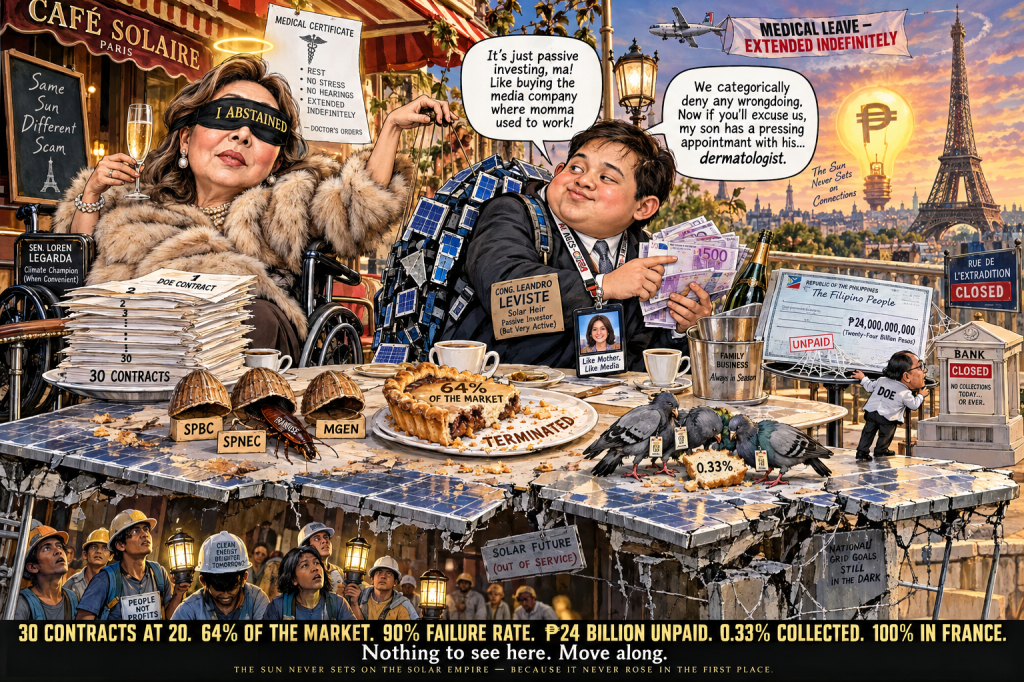
There’s a P24 billion DOE penalty that Leviste reportedly blamed Recto for. There’s an Ombudsman investigation into Leviste’s solar franchise sale. The alleged “honey trap” didn’t emerge from nowhere; it emerged from a political war where both sides have accused each other of corruption and dirty tricks.
Paras, for his part, is an opposition figure who has every reason to distrust the Marcos administration. His immediate response—calling the disbarment case “oppression and harassment” by “the Makoy Jr. Government”—is predictable but not necessarily wrong.
And Recto? He’s the Executive Secretary, arguably the second most powerful person in the country. The NBI is an executive agency. The Department of Justice (DOJ), which will evaluate the trafficking complaint, is an executive agency. The idea that the administration might have an interest in discrediting its political opponents is not conspiracy theorizing; it’s basic political analysis.
What the Defense Should Do
If I were a lawyer and representing Paras or the four lawyers—and thank God I’m not, because this case is a migraine in legal form—I would focus on three things.
- First, produce the complete Viber conversations between Paras and Ken. If they show Paras discussing legitimate investigation, the NBI’s case collapses. If they show him discussing fabrication, he’s done. Either way, sunlight is the best disinfectant.
- Second, demand that the women testify under oath. The NBI’s case is built on Ken’s account of what the women were allegedly told to say. Let’s hear from the women themselves. Did they approach Paras? Were they coached? Did they believe their allegations were true? Their testimony is the fulcrum on which this case turns.
- Third, attack the trafficking charge as legally insufficient. Because it is. There is no coherent reading of RA 9208 that converts a political dirty trick into qualified human trafficking. The NBI overcharged, probably deliberately, to make the case seem more serious than it is. A competent defense lawyer will eviscerate that theory.
The Bottom Line
The NBI may have evidence I haven’t seen. They may have messages, documents, or witnesses that establish the fabrication scheme beyond doubt. If they do, they should release it—not through selective leaks, but in full, so the public can evaluate the case on its merits rather than on the NBI’s say-so.
But based on what’s publicly available, this looks less like a slam-dunk prosecution and more like a politically charged investigation that got ahead of its evidence. The disbarment complaint reads like an afterthought, a way to punish the lawyers before the criminal case has even been evaluated by the DOJ.
The Supreme Court should be skeptical. The Court has disbarred lawyers for serious dishonesty, but it has also protected lawyers from baseless disciplinary complaints. This case will test whether the Court can distinguish between genuine misconduct and political score-settling.
As for Paras? He’s in for a fight. But if the NBI’s case is as weak as it appears, he might just survive it. And if he does, the NBI will have done more damage to its own credibility than to his.
And that, mga ka-kweba, is the kind of irony that makes covering the legal profession in this country simultaneously infuriating and endlessly entertaining.
Louis ‘Barok’ C Biraogo is a recovering idealist and unrecovered cynic. He blogs at Kweba ni Barok, where he criticizes everyone and apologizes to no one. He is not a lawyer, which means he has no professional reputation to protect and absolutely nothing to lose. The views expressed are his own and should not be attributed to anyone with better judgment.
Key Citations
A. News Articles
- Casilao, Joahna Lei. “Melvin Matibag: NBI has Viber messages on alleged plot to frame Ralph Recto.” GMA News Online, 4 Aug. 2026.
- Inquirer.net. “NBI files disbarment case vs Paras, 4 others in Recto ‘honey trap’ plot.” Philippine Daily Inquirer, 11 Sept. 2026.
- Inquirer.net. “Batangas pols Leviste, Recto trade barbs on, off social media.” Philippine Daily Inquirer, 5 May 2026.
- Porcalla, Delon, and Daphne Galvez. “Leviste vs Recto: Political scions clash over corruption.” Philstar.com, 7 May 2026.
- Pulta, Benjamin. “Ombudsman probes Legarda, son Leandro over uncompleted solar plan.” Philippine News Agency, 31 July 2026.
- Rappler. “DOE: Only 0.3% collected from P24 billion in penalties vs Leviste’s Solar Philippines.” Rappler, 2 Sept. 2026.
- Villeza, Mark Ernest. “NBI seeks disbarment of Paras, four other lawyers.” Philstar.com, 12 Sept. 2026.
- Villeza, Mark Ernest. “NBI to file human trafficking raps vs Leviste, Paras, 5 others over Recto plot.” Philstar.com, 4 Sept. 2026.
B. Legal and Official Sources
- Republic Act No. 9208. An Act to Institute Policies to Eliminate Trafficking in Persons Especially Women and Children, Establishing the Necessary Institutional Mechanisms for the Protection and Support of Trafficked Persons, Providing Penalties for Its Violations, and for Other Purposes (Anti-Trafficking in Persons Act of 2003). 26 May 2003.
- Republic Act No. 10364. An Act Expanding Republic Act No. 9208 (Expanded Anti-Trafficking in Persons Act of 2012). 6 Feb. 2013.
- Republic Act No. 11862. An Act Strengthening the Policies on Anti-Trafficking in Persons, Providing Penalties for Its Violations, and Appropriating Funds Therefor, Amending for the Purpose Republic Act No. 9208, as Amended (Expanded Anti-Trafficking in Persons Act of 2022). 2 June 2022.
- Congress of the Philippines. Republic Act No. 9208: Anti-Trafficking in Persons Act of 2003. 26 May 2003.
- Congress of the Philippines. Act No. 3815: The Revised Penal Code. 8 Dec. 1930.
- Supreme Court of the Philippines. A.M. No. 22-09-01-SC: Code of Professional Responsibility and Accountability. 11 Apr. 2023.
- Supreme Court of the Philippines. Rules on Evidence, Rules of Court (2019). A.M. No. 19-08-15-SC.
- Ablola, Saribong & Gueco. “Understanding the Burden of Proof in Lawyer Disbarment Cases: Lessons from a Philippine Supreme Court Ruling.” ASG.ph.
C. Official Websites
- Department of Justice. Republic of the Philippines.
- National Bureau of Investigation. Republic of the Philippines.
- Office of the Ombudsman. Republic of the Philippines.
- Supreme Court of the Philippines.
- Biraogo, Louis C. “About me.” Kweba ni Barok.
- ₱8B BBM Pork: CCTV for Every Captain’s Kumpare?
- ₱8.9 Billion, 331 Ghost Police Stations: The TIKAS Scandal Explained

- ₱8.4 Billion, 42,000 Barangays, 1 Election: The “Bawat Barangay Makikinabang” Vote-Buying Masterclass
- ₱75 Million Heist: Cops Gone Full Bandit

- ₱6.77B Ghost Haunts Duterte: RTC Dismisses Mans Carpio’s Desperate Plea
- ₱6.7-Trillion Temptation: The Great Pork Zombie Revival and the “Collegial” Vote-Buying Circus

- ₱53 Million Man Tells ₱695-a-Day Workers to Stop Being ‘Mayabang’: The Audacity of BSP’s Remolona
- ₱3.06 Billion for Evacuation Centers—But Nobody Knows Where They’ll Stand (Or If They’ll Exist)
- ₱10B Ghost in New Clark City: Matibag’s Haunted Séance for Cayetano

- ₱1.9 Billion for 382 Units and a Rooftop Pool: Poverty Solved, Next Problem Please

- ₱1.35 Trillion for Education: Bigger Budget, Same Old Thieves’ Banquet

- ₱1 Billion Congressional Seat? Sorry, Sold Out Na Raw — Si Bello Raw Ang Hindi Bumili


 KWEBA ni BAROK
Leave a comment