The Dredge Report: What SMC’s Own Models Reveal About the 2026 Floods (Spoiler: Everything)
By Louis ‘Barok‘ C. Biraogo — September 7, 2026
PROLOGUE: A MAN, A PLAN, A CANAL—NO, WAIT, A FLOODPLAIN
Ladies, gentlemen, and the perpetually waterlogged residents of Bulacan—gather ’round the electronic campfire once more, for we have a story that combines the vanity of Icarus, the hubris of Babel, and the moisture content of a monsoon-soaked sponge.
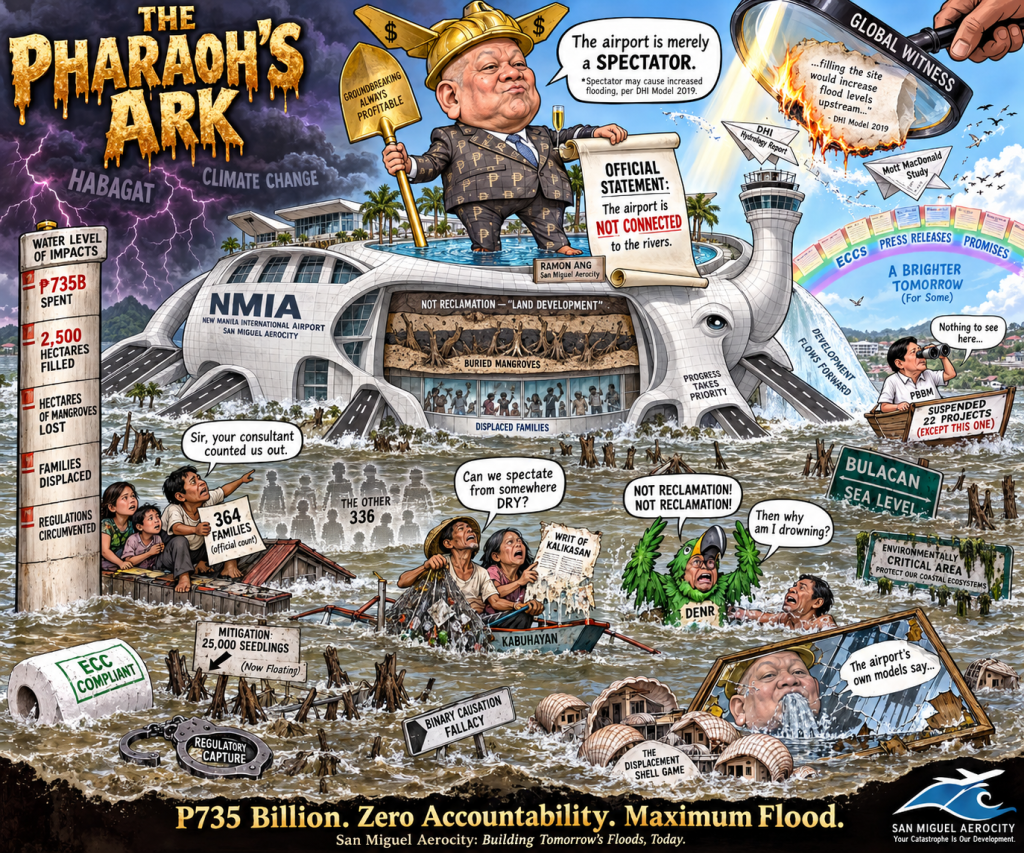
Ramon S. Ang—the man whose business card might as well read “Pharaoh-in-Chief, San Miguel Aerocity”—would have you believe that the New Manila International Airport (NMIA), his P735-billion concrete-and-fill cathedral rising from the waters of Bulakan, is as innocent of the 2026 flooding as a newborn babe. The floods, he insists, are acts of God, geography, and possibly the alignment of distant planets. The airport? Merely a spectator.
Enter Global Witness, stage left, wielding documents, expert testimony, and the kind of inconvenient facts that make corporate PR departments reach for the smelling salts. Their report—released with the subtlety of a depth charge—alleges that Ang’s denial is not merely false, but a deliberate, calculated piece of regulatory and hydrological theater.
Today, in this humble cave, we shall perform an autopsy on the corpse of that denial. We shall wield the scalpel of statutory text, the forceps of court precedent, and the bone saw of scientific evidence. The question is not whether the patient is dead—the question is how many people knew it was dying, and who kept selling tickets to the show.
ACT I: THE DOCTRINE OF “BINARY CAUSATION”—OR, WHY RAMON ANG WANTS YOU TO THINK IN BLACK AND WHITE
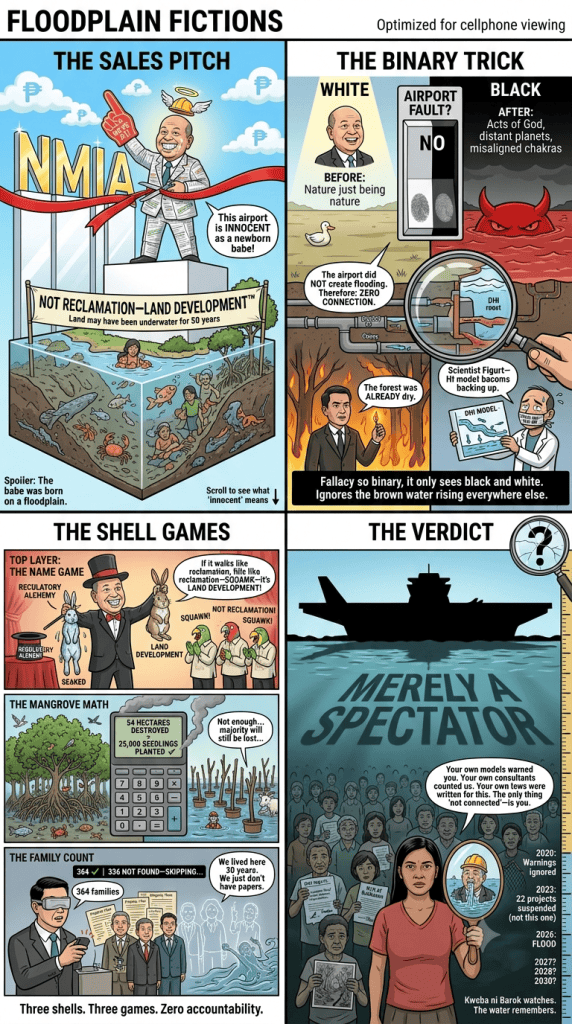
Let us begin with the rhetorical sleight-of-hand that forms the entire foundation of Ang’s defense. His position, when stripped of the corporate varnish, is essentially this:
“The airport did not create the flooding. Therefore, the airport has nothing to do with the flooding.”
This is the intellectual equivalent of a man who sets fire to a drought-stricken forest and then argues, “Well, the forest was dry and full of dead wood. The fire would have happened eventually.” It is what we in the caves call the fallacy of binary causation—the attempt to reduce a complex, incremental, multifactorial hydrological disaster into a simple yes/no question that can be answered with a press release.
The truth, as any first-year hydrology student knows, is that floodplains are not passive observers. They are active, living, breathing systems. They are the lungs that absorb storm surge, the kidneys that filter tidal inflow, and the shock absorbers that cushion the violence of a Habagat.
When you take 2,500 hectares of that floodplain, fill it with dredged material from the seabed, and seal it under an impermeable airport platform, you are not a bystander. You are, in a very literal sense, removing the patient’s organs and then claiming you had nothing to do with the subsequent death.
The project’s own engineering documentation—prepared by DHI and Mott MacDonald, the very consultants paid by San Miguel—admits as much. Their models show that filling the site would:
- Close an existing tidal channel
- Eliminate overland flood-flow paths
- Increase flood levels upstream
- Increase runoff due to new impermeable surfaces
Ang’s response to this? He argues that the airport is “not connected to the rivers.” This is like a burglar arguing he is not connected to the broken window because he used a glass cutter.
The relevant question is not whether the airport is a tributary of the Angat River. The relevant question is whether converting a floodplain into a concrete platform alters water levels, drainage times, runoff, tidal exchange, and flow distribution elsewhere. The DHI model says yes. The only people saying no are on San Miguel’s payroll or its board of directors.
This is not science. This is corporate theology. And the congregation of the faithful—the Department of Environment and Natural Resources (DENR), the Department of Transportation (DOTr), and the regulatory choir—have been singing from Ang’s hymnbook for years.
ACT II: THE LEGAL FICTION OF “LAND DEVELOPMENT”—A MASTERCLASS IN REGULATORY ALCHEMY
Now we come to the centerpiece of the entire scandal: the claim that NMIA is not a reclamation project, but merely the “development” of pre-existing titled land. Ang’s argument is that because the area was once above water, had titles, and later became fishponds, the massive dumping of fill to create an elevated airport platform is not “reclamation.”
Let us pause to appreciate the sheer audacity of this linguistic maneuver. It is the legal equivalent of a man claiming that because his car was once parked in a garage, he is not “driving” it while it is wrapped around a lamppost. The fact that the land was once above water is irrelevant to the question of what is being done to it now. What is being done now—by San Miguel’s own admission—is the placement of millions of cubic meters of dredged material over areas that are permanently submerged.
Global Witness obtained expert criticism of precisely this point. Dr. Murtah Shannon of Both ENDS put it bluntly: “Saying it is land development because the area was once above water is like saying reclaimed land is ocean because the area was once under water.” The classification is not a scientific judgment. It is a regulatory escape hatch, engineered to avoid the scrutiny that would come with being labeled a reclamation project.
And oh, what scrutiny that would be! Recall that in August 2023, President Ferdinand Marcos Jr.—he of the famous “I am not a thief” defense—ordered the suspension of 22 Manila Bay reclamation projects. He warned, with uncharacteristic prescience, that reclamation could obstruct rivers. But NMIA, by the magic of this “land development” classification, was exempted. It proceeded without interruption. The dredgers kept dredging. The fill kept filling. And the floodplain kept disappearing.
The legal framework is clear. Presidential Proclamation No. 2146 identifies major reclamation projects and areas frequently hit by floods as environmentally critical projects requiring the highest level of scrutiny. The Water Code (PD 1067) prohibits lower estates from obstructing natural water flow and allows the government to regulate activities that aggravate flooding. The Local Government Code (RA 7160) requires consultation with affected communities for projects that may cause “pollution, climatic change, depletion of resources, loss of agricultural/forest cover, or extinction of species.”
Did any of this happen? The evidence suggests a systematic campaign to avoid, evade, and circumvent these requirements. The Environmental Compliance Certificate (ECC) process—the supposed guardian of environmental integrity—was apparently subverted through the acquisition of a shell company (Silvertides Holdings) that had already obtained an ECC for “land development.” This is not regulatory compliance. This is regulatory sabotage.
ACT III: THE MANGROVE MASSACRE—OR, HOW TO DESTROY A NATURAL FLOOD BARRIER AND CALL IT “MITIGATION”
Let us now turn to the mangroves. Ah, the mangroves. Those humble, salt-tolerant trees that have been protecting coastlines from storm surges, filtering pollutants, storing carbon, and providing fish nurseries for millions of years. In the path of the NMIA, they were an obstacle. And so, they were removed. Approximately 54 hectares of them, according to the project’s own Environmental and Social Impact Assessment (ESIA).
San Miguel’s defense? They have a plan to plant new mangroves. Twenty-five thousand of them. They call it “mitigation.” Global Witness, citing independent scientists, calls it “greenwashing.” The DENR, in a rare moment of regulatory clarity, ordered a halt to the planting in 2021. The Philippine Coast Guard (PCG) assessed that the replanting was “not enough; majority will still be lost.”
The legal framework here is devastating to San Miguel’s position. Section 94 of RA 8550 (the Fisheries Code) makes it unlawful to convert mangroves for any purpose. This is not a “pay to play” provision. It is a prohibition. The penalties include imprisonment and fines. The Wildlife Resources Conservation and Protection Act (RA 9147) adds additional layers of protection. And if the area is a statutory protected area under the National Integrated Protected Areas System (NIPAS) Act (RA 11038), the restrictions are even more severe.
But here is the key legal point that Ang and his lawyers will not want you to notice: a mature mangrove ecosystem is not replaceable by planting seedlings somewhere else. The relevant metric is not tree-count arithmetic. It is functional ecological equivalence. A hundred seedlings in a mitigation site do not replace the carbon stock, sediment dynamics, fish nursery function, and storm-surge protection of an established mangrove forest. To argue otherwise is to engage in the kind of magical thinking that would make an alchemist blush.
The “offset” controversy is not a minor detail. It is a fundamental failure of due diligence. And it raises a question that should make every prosecutor’s ears perk up: Did San Miguel know that its “mitigation” was scientifically inadequate, and did it proceed anyway? If the answer is yes, we are no longer talking about environmental negligence. We are talking about environmental fraud.
ACT IV: THE DISPLACEMENT SHELL GAME—COUNTING FAMILIES LIKE THEY COUNT SHEEP
Now we come to the human cost. Global Witness reports that communities identified approximately 700 families facing displacement. Mott MacDonald, the international consultant hired by San Miguel, identified 364 affected families. Of those, only 277 were deemed eligible for compensation.
Let us do the arithmetic, shall we? Seven hundred minus 364 equals 336 families—more than half the community’s estimate—that were apparently invisible to the consultant’s sophisticated counting methods. That is not a rounding error. That is a statistical massacre.
The legal implications are profound. RA 7160 (the Local Government Code) requires consultation with affected sectors. RA 10752 (the Right-of-Way Act) mandates prompt and just compensation for those displaced by infrastructure projects. The Philippine Constitution, in Article XIII, requires that the State “resettle the landless and the urban poor” and that “no eviction or demolition shall be allowed without adequate relocation.”
But here is the rub: who counts as an “affected person”? San Miguel’s consultants seem to have adopted a narrow, title-based definition. But the reality on the ground—in the fishponds, the mangrove swamps, the tidal flats—is that thousands of people depend on these ecosystems for their livelihoods. Fisherfolk, tenant fishpond operators, seasonal workers, and informal settlers are all affected. They may not hold formal titles, but they are economically displaced. To exclude them from the compensation pool is to commit a form of institutional violence.
The consultation process, according to Global Witness, was a farce. The public presentation in February 2019 was for “land development” and made no mention of an airport. Military and police were present. Activists were “red-tagged” (a Philippine euphemism for being branded as communist sympathizers, often with deadly consequences). House-to-house consultations were conducted only after the community reacted negatively to the project. The whole process violated every principle of Free, Prior, and Informed Consent (FPIC) that the Philippines has committed to under international law.
This is not consultation. This is coercion with a veneer of formality.
ACT V: THE REGULATORY CAPTURE—HOW THE STATE BECAME THE CORPORATE PARROT
Let us now turn our gaze to the government agencies that were supposed to protect the public interest. The DENR. The Environmental Management Bureau (EMB). The Philippine Reclamation Authority (PRA). The DOTr. The Department of Finance (DOF). The Office of the President. What have they done in the face of this unfolding disaster?
They have, for the most part, parroted the corporate line. They have accepted project-funded studies as independent. They have relied on proponent-generated data. They have classified reclamation as “land development.” They have issued ECCs based on incomplete information. They have failed to verify mitigation compliance. They have ignored the warnings of their own technical staff (the PCG’s assessment of mangrove replanting, for example). They have allowed a massive coastal floodplain transformation to proceed without independent replication of the hydrological models.
This is the classic pattern of regulatory capture: the subordination of public interest to private power. It is not necessarily corruption in the crude sense of cash-stuffed envelopes. It is something subtler and more insidious: a structural dependency on the very entity being regulated. The government needs the project to succeed—for economic growth, for infrastructure development, for political prestige. And so, it becomes a partner rather than a regulator. It becomes a corporate parrot, repeating the phrases it is fed.
The Supreme Court has provided a remedy for this. In MMDA v. Concerned Residents of Manila Bay (2008), the Court issued a continuing mandamus directing government agencies to clean up and preserve Manila Bay. The Writ of Kalikasan, established by the Rules of Procedure for Environmental Cases (A.M. No. 09-6-8-SC), is available where environmental damage of such magnitude as to prejudice life, health, or property of inhabitants in two or more cities or provinces is caused or threatened. The fisherfolk of Bulacan filed such a petition in December 2020. It remains pending. Justice, as they say, delayed is justice denied. But for the residents of Bulacan who watched their homes flood for the third time in a decade, delay is not merely an inconvenience. It is an existential threat.
ACT VI: THE GLOBAL WITNESS REPORT—ADVOCACY OR EVIDENCE?
Let us be fair. Global Witness is an advocacy organization. It has an agenda. It is not a peer-reviewed scientific journal. Its report is a compilation of expert interviews, documentary analysis, and community testimony. It is not a hydrological model.
But here is the thing: it does not need to be a hydrological model to be devastating. The strongest evidence against Ramon Ang does not come from Global Witness. It comes from San Miguel’s own engineering consultants. The DHI model. The Mott MacDonald ESIA. The project’s own admission that filling the floodplain would increase upstream flooding. The project’s own acknowledgment that mitigation (river dredging, channel improvements) was necessary.
Global Witness’s contribution is not to prove causation. It is to expose the contradiction between the project’s own science and the public-relations narrative of its CEO. That contradiction is the smoking gun. And it is a smoking gun that does not require a peer-reviewed study to be recognized.
ACT VII: WHAT IS TO BE DONE? A MODEST PROPOSAL FOR THE CITIZENRY
The NMIA controversy is not going away. The flooding will recur. The seas will rise. The project will continue to alter the hydrology of Manila Bay. The question is whether the Philippine state will finally assert its authority and demand accountability.
The path forward is clear:
- Independent Technical Audit. The government must commission a genuinely independent hydrological model—not one funded by San Miguel, not one prepared by DHI, but one supervised by the University of the Philippines, the Department of Science and Technology (DOST), the National Mapping and Resource Information Authority (NAMRIA), and international experts with no financial stake in the project. The raw data, assumptions, and model parameters must be made public.
- Reclassification. The DENR and PRA must formally determine whether the actual physical transformation of the site constitutes reclamation under Philippine law. The question is not what the developer calls it. The question is what is physically occurring. If it walks like a reclamation, fills like a reclamation, and destroys mangroves like a reclamation, it is a reclamation.
- ECC Compliance Audit. The government must verify whether the mitigation measures promised in the ECC have actually been implemented. If the DHI model says “airport + mitigation = no significant additional flood risk,” but reality is “airport + incomplete mitigation = increased risk,” then the ECC has been violated and must be enforced.
- Displacement Census. An independent census of all affected families must be conducted, using a definition of “affected” that includes livelihood-dependent households, not just title holders. Compensation and relocation must be provided in accordance with the Constitution and RA 10752.
- Legal Accountability. The fisherfolk’s Writ of Kalikasan petition must be heard. The violations of RA 8550 (mangrove conversion) must be prosecuted. The regulatory irregularities must be investigated. The individuals responsible—including corporate officers where the law provides for such liability—must be held to account.
- Public Transparency. San Miguel must release the complete DHI flood assessments, the full Mott MacDonald ESIA, the ECC amendments, the dredging records, and the compensation records. If Ang is so confident that the airport is innocent, let him prove it with data. The court of public opinion is watching.
EPILOGUE: THE VERDICT OF THE CAVE
Ramon Ang is a brilliant businessman. He has built an empire. He has transformed Philippine infrastructure. But on the question of NMIA and flooding, he is caught in a web of his own making. His categorical denial that the airport has “nothing to do” with flooding is contradicted by his own consultants. His claim that the project is “land development” is a legal fiction that would be laughable if it were not so consequential. His mangrove “mitigation” is greenwashing. His displacement count is a shell game. And the government agencies that should have protected the public interest have instead become his corporate parrots.
The Daily Tribune headline—”Int’l study demolishes Ang’s flooding claims”—is overstated. Global Witness does not “demolish” every component of his argument. But it does something more important: it exposes the contradiction at the heart of his defense. The strongest case against San Miguel is not that the airport caused the floods. It is that the airport’s own engineering studies acknowledge that it can increase flood risk, and that San Miguel has failed to demonstrate that its mitigation measures are actually implemented and effective.
The burden of proof has shifted. It is no longer enough for Ang to say, “The airport did not cause the floods.” He must now answer a more difficult question: “Why did your own consultants say it could, and what did you do about it?”
Until he answers that question with data—not denials—the residents of Bulacan and Pampanga will continue to wade through the consequences of his cathedral of denial.
And the cave will continue to watch.
Barok out.
Kweba ni Barok is a fictional blog for satirical and analytical purposes. All characters, events, and corporate malfeasance described herein are real. Any resemblance to persons living, dead, or politically untouchable is entirely intentional.
Key Citations
A. Reports & Studies
- Global Witness. Runaway Risk. 2 Feb. 2023, www.globalwitness.org/en/campaigns/holding-corporates-account/runaway-risk.
- Global Witness. Sunk Costs: A Mega-Airport in the Path of Climate Disaster. 27 Jan. 2025, www.globalwitness.org/en/campaigns/forests/sunk-costs-a-mega-airport-in-the-path-of-climate-disaster/.
- Mott MacDonald. New Manila International Airport: Non-Technical Summary of the Environmental and Social Impact Assessment (ESIA). Apr. 2022, www.sanmiguel.com.ph/storage/files/reports/409686-02-V0-C_ESIA_for_NMIA-NTS_20220412-Clean.pdf.
B. News Articles
- Reuters. “Philippines Suspends Nearly 2 Dozen Manila Bay Reclamation Projects.” 10 Aug. 2023, www.reuters.com/world/asia-pacific/philippines-suspends-nearly-2-dozen-manila-bay-reclamation-projects-2023-08-10/.
- Cabico, Gaea Katreena. “Taliptip Fishers, Groups File Writ of Kalikasan vs Bulacan Airport Project.” Philstar.com, 15 Dec. 2020, www.philstar.com/headlines/2020/12/15/2064016/taliptip-fishers-groups-file-writ-kalikasan-vs-bulacan-airport-project.
- Loyola, James A. “RSA: First Runway of ₱735-Billion Airport Could Open Early.” Manila Bulletin, 9 June 2026, mb.com.ph/2026/06/09/rsa-first-runway-of-735-billion-airport-could-open-early.
- “Scuttlebutt.” Daily Tribune, 17 Aug. 2025, tribune.net.ph/2025/08/17/scuttlebutt-334.
C. Official Websites & Legal Sources
- Proclamation No. 2146. 14 Dec. 1981, chanrobles.com/proclamationo2146.htm.
- Presidential Decree No. 1067 (Water Code of the Philippines). 31 Dec. 1976, www.officialgazette.gov.ph/1976/12/31/presidential-decree-no-1067-s-1976/.
- Republic Act No. 7160 (Local Government Code of 1991). 10 Oct. 1991, www.officialgazette.gov.ph/1991/10/10/republic-act-no-7160/.
- Republic Act No. 8550 (Philippine Fisheries Code of 1998). 25 Feb. 1998, www.officialgazette.gov.ph/1998/02/25/republic-act-no-8550/.
- Republic Act No. 9147 (Wildlife Resources Conservation and Protection Act). 30 July 2001, www.officialgazette.gov.ph/2001/07/30/republic-act-no-9147/.
- Republic Act No. 11038 (Expanded National Integrated Protected Areas System Act). 22 June 2018, www.officialgazette.gov.ph/2018/06/22/republic-act-no-11038/.
- Republic Act No. 10752 (Right-of-Way Act). 7 Mar. 2016, www.officialgazette.gov.ph/2016/03/07/republic-act-no-10752/.
- The 1987 Constitution of the Republic of the Philippines. www.officialgazette.gov.ph/constitutions/1987-constitution/.
- Supreme Court of the Philippines. Metropolitan Manila Development Authority v. Concerned Residents of Manila Bay, G.R. Nos. 171947-48, 18 Dec. 2008, elibrary.judiciary.gov.ph/thebookshelf/showdocs/1/47261.
- Supreme Court of the Philippines. Rules of Procedure for Environmental Cases, A.M. No. 09-6-8-SC, elibrary.judiciary.gov.ph/thebookshelf/showdocs/11/39990.
- San Miguel Corporation. www.sanmiguel.com.ph.

- ₱9 Billion in ‘Savings’? DILG’s Fire Truck Deal Smells Like Smoke

- ₱8B BBM Pork: CCTV for Every Captain’s Kumpare?

- ₱8.9 Billion, 331 Ghost Police Stations: The TIKAS Scandal Explained

- ₱8.4 Billion, 42,000 Barangays, 1 Election: The “Bawat Barangay Makikinabang” Vote-Buying Masterclass

- ₱75 Million Heist: Cops Gone Full Bandit

- ₱6.77B Ghost Haunts Duterte: RTC Dismisses Mans Carpio’s Desperate Plea

- ₱6.77 Billion and Zero Cash: The Sara Duterte SALN Math That Doesn’t Add Up

- ₱6.7-Trillion Temptation: The Great Pork Zombie Revival and the “Collegial” Vote-Buying Circus

- ₱58.53B, Zero Receipts: The LGSF Pork Barrel Nobody Wants to Name
- ₱53 Million Man Tells ₱695-a-Day Workers to Stop Being ‘Mayabang’: The Audacity of BSP’s Remolona

- ₱4.4 Billion and a Witness Who Can’t Explain It: The Duterte Impeachment’s Most Expensive Non-Answer

- ₱3.06 Billion for Evacuation Centers—But Nobody Knows Where They’ll Stand (Or If They’ll Exist)




Leave a Reply